Klassifizierung / Names
Namen | Synonyme | Catalog of Fishes(Gattung, Arten) | ITIS | CoL | WoRMS | Cloffa
>
Cypriniformes (Carps) >
Nemacheilidae (Brook loaches)
Etymology: Schistura: Greek, schizein = to divide + Greek, oura = tail; an allusion to forked caudal fins (Ref. 45335); nebeshwari: Named for Kongrailakpam Nebeshwar Sharma in recognition of his assistance to the authors during the field work in Mizoram. A noun in the genitive case.
Eponymy: Dr Kongrailakpam Nebeshwar Sharma is an Indian biologist and ichthyologist. [...] (Ref. 128868), visit book page.
Umwelt: Milieu / Klimazone / Tiefenbereich / Verbreitungsgebiet
Ökologie
; süßwasser demersal. Tropical
Asia: Kolchaw River and a stream near Phura village near Palak Lake (the Koladyne basin) in Mizoram, India.
Größe / Gewicht / Alter
Geschlechtsreife: Lm ? range ? - ? cm
Max length : 5.5 cm SL Männchen/unbestimmt; (Ref. 94459)
Kurzbeschreibung
Bestimmungsschlüssel | Morphologie | Morphometrie
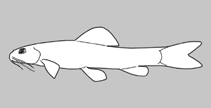
Rückenflossenweichstrahlen (insgesamt) : 11 - 12; Afterflossenweichstrahlen: 8. Schistura nebeshwari differs from other congeners with a dorsal adipose crest on the caudal peduncle by the combination of the following characters: body with 11-14 dark olivaceous bars; entire ventral surface of head with numerous small melanophores; incomplete lateral line, three black spots at the dorsal-fin base; a complete prominent black basicaudal bar; lower jaw with a shallow median notch; suborbital flap absent in males; cheek inflated; and deep caudal peduncle with prominent dorsal adipose crest (Ref. 94459).
Body shape (shape guide): elongated.
This species usually inhabits brooks and streams with slow to swift current, among small pebbles, stones, and boulders in southern Mizoram. Its holotype was collected from a stream near Phura village near Palak Lake (the Koladyne basin), among small pebbles, in slow current. Three paratypes were caught from the Kolchaw River near Kolchaw in Saiha District, Mizoram. This species co-occurs with the following fishes: Olyra sp. (Bagridae); Barilius profundus, Devario sp., Pethia sp., Garra sp. (Cyprinidae); Schistura scyphovecteta (Nemacheilidae); and Glyptothorax jayarami (Sisoridae) (Ref. 94459).
Lebenszyklus und Paarungsverhalten
Geschlechtsreife | Fortpflanzung | Ablaichen | Eier | Fruchtbarkeit | Larven
Lokeshwor, Y. and W. Vishwanath, 2013. Two new species of stone loaches of the genus Schistura from the Koladyne basin Mizoram, India (Teleostei: Cobitoidei: Nemacheilidae). Zootaxa 3731(4):561-576. (Ref. 94459)
IUCN Rote Liste Status (Ref. 130435: Version 2025-2 (Global))
Bedrohung für Menschen
Harmless
Nutzung durch Menschen
Fischereien: nicht kommerziell
Tools
Zusatzinformationen
Download XML
Internet Quellen
Schätzungen auf der Grundlage von Modellen
Phylogenetischer Diversitätsindex (Ref.
82804): PD
50 = 0.5000 [Uniqueness, from 0.5 = low to 2.0 = high].
Bayesian length-weight: a=0.00708 (0.00323 - 0.01553), b=3.03 (2.86 - 3.20), in cm total length, based on LWR estimates for this Genus-body shape (Ref.
93245).
Trophische Ebene (Ref.
69278): 3.0 ±0.3 se; based on size and trophs of closest relatives
Widerstandsfähigkeit (Ref.
120179): mittel, Verdopplung der Population dauert 1,4 - 4,4 Jahre. (Preliminary K or Fecundity.).
Anfälligkeit der Fischerei (Ref.
59153): Low vulnerability (10 of 100).
🛈