वर्गीकरण / नाम
आम नाम | उपशब्द | Catalog of Fishes(वर्ग, प्रजाति) | ITIS | CoL | WoRMS | Cloffa
>
Cypriniformes (Carps) >
Cyprinidae (Minnows or carps) > Torinae
Etymology: Hypselobarbus: Greek, hypselos = high + Latin, barbus =barbel (Ref. 45335).
Eponymy: A toponym referring to the village of Kushavali in the Western Ghats of India, where the Kali River (type locality) originates. (Ref. 128868), visit book page.
पर्यावरण: पर्यावरण / जलवायु क्षेत्र / गहराई सीमा / वितरण सीमा
पारिस्थितिकी
; स्वच्छ जल, अलवण जल बेनथोपिलाजिक. Tropical
Asia: Kali River, Karnataka, India.
आकार / वज़न / आयु
परिपक्व अवधि: Lm ? range ? - ? cm
Max length : 31.0 cm SL पुल्लिंग / अलिंग; (Ref. 119237)
संक्षिप्त वर्णन
पहचान कुंजी | आकृति विज्ञान | मौरफोमैटरिक्स
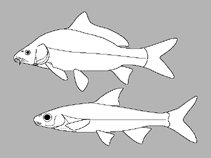
पृष्ठीय सौफट रेज़ (सम्पूर्ण) : 13; ऐनल सौफट रेज़: 8. Hypselobarbus kushavali is distinguished from other congeners except H. pulchellus based on the lateral-line scale count of 31-32. It can be diagnosed from H. pulchellus by the lack of a lateral band (vs. presence). It differs from H. dobsoni and H. jerdoni by the lack of fin coloration (vs. the tips of the dorsal and caudal fins are black in H. jerdoni and H. dobsoni). It can be diagnosed from H. dobsoni in having 6.5 upper transverse scale rows (vs. 5.5), 4.5 lateral line to pelvic scale rows (vs. 3.5), 26 circumferential scale rows (vs. 24), and the morphometric characters of greater distance between origin of dorsal fin to origin of anal fin (33.68-36.24 vs. 30.53-31.40 %SL), greater body depth (40.19-42.38 vs. 33.18-37.64 %SL) and wider inter-orbital width (46.65-49.10 vs. 38.52-41.80 % HL). It is distinguished from H. jerdoni in having 31-32 scales on lateral line (vs. 27-29), 26 circumferential scale rows (vs. 23-24) and the morphometric characters of shorter caudal fin length (22.01-26.12 vs. 34.96-37.80 % SL) and greater interorbital width (46.65-49.10 vs. 35.73-40.01 % HL). It can be differentiated from H. bicolor in having 31-32 scales on lateral line (vs. 35-37), 13 circumpeduncular scale rows (vs. 16) and the morphometric character of a greater distance between dorsal-fin origin and pelvic-fin insertion (37.69-41.10 vs. 26.37-30.37 %SL) (Ref. 119237)
Body shape (shape guide): fusiform / normal.
Inhabits rivers, preferring deep pools and riffles with slow to moderately fast current and substrate mostly composed of large boulders (Ref. 119237).
जीवन चक्र और संभोग व्यवहार
परिपक्व अवधि | पुनरुत्पत्ति | मछलीऔ का अंडे देना | अंडे | उपजाऊपन | लार्वा
Arunachalam, M., S. Chinnaraja, P. Sivakumar and R.L. Mayden, 2016. Description of a new species of large barb of the genus Hypselobarbus (Cypriniformes: Cyprinidae) from Kali River, Karnataka region of Western Ghats, peninsular India. Iran. J. Ichthyol. 3(4): 266-274. (Ref. 119237)
आईयूसीएन रेड लिस्ट स्थिति (Ref. 130435: Version 2025-2 (Global))
मनुष्यों के लिए ख़तरा
Harmless
मानव उपयोग
साधन
विशेष रिपोर्ट
XML डाउनलोड करें
इंटरनेट स्रोत
मॉडल पर आधारित अनुमान
जातिवृति विविधता सूचकांक (संदर्भ
82804): PD
50 = 0.5000 [Uniqueness, from 0.5 = low to 2.0 = high].
Bayesian length-weight: a=0.00955 (0.00430 - 0.02123), b=3.02 (2.83 - 3.21), in cm total length, based on LWR estimates for this (Sub)family-body shape (Ref.
93245).
लौटाव (संदर्भ
120179): माध्यम, न्यूनतम जनसंख्या दुगनी होने का समय 1.4 - 4.4 वर्ष। (Preliminary K or Fecundity.).
मछली पकड़ने की भेद्यता (Ref.
59153): Low to moderate vulnerability (28 of 100).
🛈