Classificatie / Namen
Lokale namen | Synoniemen | Catalog of Fishes(Genus, Soort(en)) | ITIS | CoL | WoRMS | Cloffa
>
Cichliformes (Cichlids, convict blennies) >
Cichlidae (Cichlids) > Cichlinae
Etymology: Crenicichla: Latin, crenulatus = cut, clipped + Greek, kichle = wrasse (Ref. 45335); ploegi: Named in honor of the Dutch ichthyologist Alex Ploeg (Ref. 119086).
Eponymy: Dr Alex A Ploeg (d: 2014) was a Dutch ichthyologist who was Secretary General of Ornamental Fish International (2004–2014) and Secretary General of the European Pet Organization (2006–2014). [...] (Ref. 128868), visit book page.
Milieu: milieu / Klimaatzone / Diepte / verspreidingsgebied
Ecologie
; zoet water benthopelagisch. Tropical
South America, Brazil
Grootte / Gewicht / Leeftijd
Maturiteit: Lm ? range ? - ? cm
Max length : 19.0 cm SL mannelijk / geslacht onbekend; (Ref. 119086); 11.6 cm SL (female)
Korte beschrijving
Determinatiesleutels | Morfologie | Morfometrie
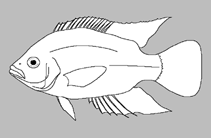
Dorsale stekels (totaal) : 18 - 20; Dorsale zachte stralen (totaal) : 13 - 15; Anale stekels: 3; Anale zachte stralen: 9 - 12. Diagnosis: Crenicichla ploegi is placed in the C. saxatilis species group by having a humeral blotch even in the smallest specimens observed, less than 80 scales in the E1 row (58–71), dimorphic males with many light dots scattered on the flank, and infraorbital series with very slender lacrimal bone and 5 separate post-lacrimal tubular infraorbitals; distinguished from all other species of the C. saxatilis group by the presence of dark spots and vermiculations on snout, interorbital area and dorsally on head in many adults up to 146.6 mm SL vs. dark markings absent or present only in juveniles but absent in adults (head uniformly dark gray in adults from 80 mm SL), and by the presence of a deep and strongly pigmented lateral band present in both juveniles and adults, occupying a depth of 4–6 horizontal scale rows vs. lateral band narrower, occupying a depth of 2–3 horizontal scale rows, and conspicuous only in juveniles and smaller specimens, faded or absent in larger specimens; Crenicichla ploegi is more elongate (body depth 17.8–21.7% SL) and has more scales in the E1 row (58–71 scales) than C. brasiliensis, C. britskii, C. frenata, C. isbrueckeri, C. labrina, C. lepidota, C.proteus, C. santosi, C. saxatilis and C. semicincta (body depth more than 21% SL, and fewer than 56 scales in the E1 row); Crenicichla ploegi differs from C. alta, C. albopunctata, C. anthurus, C. coppenamensis, C. pydanielae and C. sipaliwini by having the humeral blotch situated almost entirely below the anterior branch of the lateral line vs. humeral blotch with center on the level of the anterior branch of the lateral line (Ref. 119086).
Body shape (shape guide): elongated; Cross section: oval.
Levenscyclus en paargedrag
Maturiteit | Voortplanting | Paaien | Eieren | Fecunditeit | Larven
Varella, H.R., M.V. Loeb, Lima F.C.T. and S.O. Kullander, 2018. Crenicichla ploegi, a new species of pike-cichlid of the C. saxatilis group from the Rio Juruena and upper Rio Paraguai basins in Brazil, with an updated diagnosis and biogeographical comments on the group (Teleostei: Cichlidae). Zootaxa 4377(3):361-386 (Ref. 119086)
Status op de Rode Lijst van het IUCN (Ref. 130435: Version 2025-2 (Global))
Gevaar voor de mens
Harmless
Gebruik door de mens
Tools
Speciale rapporten
Download XML
Internetbronnen
Schattingen op basis van modellen
Fylogenetische diversiteitsindex (Ref.
82804): PD
50 = 0.5000 [Uniqueness, from 0.5 = low to 2.0 = high].
Bayesian length-weight: a=0.00741 (0.00332 - 0.01655), b=3.11 (2.94 - 3.28), in cm total length, based on LWR estimates for this Genus-body shape (Ref.
93245).
Trofisch niveau (Ref.
69278): 3.3 ±0.5 se; based on size and trophs of closest relatives
Weerstandsvermogen (Ref.
120179): Hoog, minimale populatieverdubbelingstijd minder dan 15 maanden (Preliminary K or Fecundity.).
Kwetsbaarheid van de visserij (Ref.
59153): Low vulnerability (13 of 100).
🛈