>
Gobiesociformes (Clingfishes) >
Gobiesocidae (Clingfishes and singleslits) > Protogobiesocinae
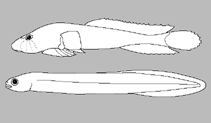
Etymology: Protogobiesox: ‘‘ancestral gobiesocid;’’ it refers to the pelvic fins resembling the putative ancestral form of gobiesocids; asymmetricus: Named for the unusual asymmetry of head and body.
Environnement : milieu / zone climatique / profondeur / gamme de distribution
Écologie
marin démersal; profondeur 370 - 560 m (Ref. 117884). Deep-water
Western Pacific: Papua New Guinea.
Taille / Poids / Âge
Maturité: Lm ? range ? - ? cm
Max length : 6.0 cm SL mâle / non sexé; (Ref. 117884); 5.9 cm SL (female)
Description synthétique
Clés d'identification | Morphologie | Morphométrie
Rayons mous dorsaux (Total) : 9 - 10; Rayons mous anaux: 8; Vertèbres: 34 - 35. Dorsal-fin rays 9-10; anal-fin rays 8; pectoral-fin rays 17-24; principal caudal-fin rays15, gills3, the third arch with 3 gill rakers; total vertebrae 34-35, with asymmetrical lateral bending starting behind the skull, bent at an angle of 85°-92°; asymmetrical skull in frontal view; naked skin, surface of head and body without striae; disc without adhesive papillae; posterior margin may be partially fringed; region B small, left- and right-hand sides separate, larger on the right-hand side than on left-hand side (Ref. 117884).
Body shape (shape guide): elongated; Cross section: compressed.
Found in relatively cool water in an area with temporary upwelling along the northern coast of
Papua New Guinea and in association with sunken logs; its specializations and especially the lateral asymmetry may be useful to be attached to these logs (Ref. 117884).
Cycle de vie et comportement reproducteur
Maturité | Reproduction | Frai | Œufs | Fécondité | Larves
Fricke, R., J.-N. Chen and W.-J. Chen, 2016. New case of lateral asymmetry in fishes: A new subfamily, genus and species of deep water clingfishes from Papua New Guinea, western Pacific Ocean. C.R. Biologies 340:47-62. (Ref. 117884)
Statut dans la liste rouge de l'IUCN (Ref. 130435: Version 2025-2 (Global))
Menace pour l'homme
Harmless
Utilisations par l'homme
Outils
Articles particuliers
Télécharger en XML
Sources Internet
Estimations basées sur des modèles
Indice de diversité phylogénétique (Réf.
82804): PD
50 = 1.0000 [Uniqueness, from 0.5 = low to 2.0 = high].
Bayesian length-weight: a=0.00389 (0.00180 - 0.00842), b=3.12 (2.94 - 3.30), in cm total length, based on all LWR estimates for this body shape (Ref.
93245).
Niveau trophique (Réf.
69278): 3.3 ±0.3 se; based on size and trophs of closest relatives
Résilience (Réf.
120179): Milieu, temps minimum de doublement de population : 1,4 à 4,4 années (Preliminary K or Fecundity.).
Vulnérabilité de la pêche (Ref.
59153): Low vulnerability (10 of 100).
🛈