Classificazione / Nomi
Nomi Comuni | Sinonimi | Catalog of Fishes(Genere, Specie) | ITIS | CoL | WoRMS | Cloffa
>
Gobiiformes (Gobies) >
Gobiidae (Gobies) > Gobionellinae
Etymology: Oxyurichthys: Greek, oxys = sharpen + Greek, oura = tail + Greek, ichthys = fish (Ref. 45335); rapa: Named for its type locality, the island of Rapa (French Polynesia); noun in apposition.
Ambiente: milieu / zona climatica / distribuzione batimetrica / gamma di distribuzione
Ecologia
marino demersale; distribuzione batimetrica 0 - 1 m (Ref. 103856). Tropical
Eastern Pacific: Rapa (Fr. Polynesia).
Dimensione / Peso / Età
Maturità: Lm ? range ? - ? cm
Max length : 5.7 cm SL maschio/sesso non determinato; (Ref. 103856); 6.6 cm SL (female)
Breve descrizione
Chiavi di identificazione | Morfologia | Morfometria
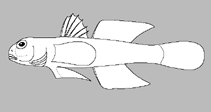
Spine dorsali (totale) : 7; Raggi dorsali molli (totale) : 12 - 13; Spine anali: 1; Raggi anali molli: 13. This species is distinguished by the following characters: D2 13 dorsal-fin elements and 14 anal-fin elements; upper jaw with a single row of teeth; fleshy tongue is rounded; upper lip is not constricted at the premaxillary symphysis; presence of a black spot on dorsoposterior surface of eye, without cirrus or cornification; anterior nares possess a dark anteromedial spot; presence of a broad dusky to dark brown area covering gular region beneath preopercle and anterior process of quadrate; dorsum scales without dark spots on posterior margin; mid-side with 4 oval to rounded dusky to brown blotches, interspersed with dusky spots and indistinct oblique bars, the fifth basicaudal blotch rounded to triangular; nape naked, with a low membranous crest; weak ctenoid scales laterally on trunk, reaching anterior to second dorsal-fin origin, scales cycloid anteriorly; naked prepelvic area; lateral scales 60–81 (modally 70); first dorsal-fin spines are elongate with filamentous tips, reaching fourth to eighth second dorsal-fin element when appressed in females, beyond second dorsal-fin, terminus in males; pectoral-fin rays 19-20; pelvic fins are blackish with pale frenum; first dorsal fin is dusky with 3 blackish lines crossing fin, leading edge of first spine black (Ref. 103856).
Body shape (shape guide): elongated; Cross section: compressed.
Specimens were collected over mud and rock substrate at depths between 0-0.5 m (Ref. 103856).
Ciclo vitale e comportamento di accoppiamento
Maturità | Riproduzione | Deposizione | Uova | Fecondità | Larve
Pezold, P.L. and H.K. Larson, 2015. A revision of the fish genus Oxyurichthys (Gobioidei: Gobiidae) with descriptions of four new species. Zootaxa 3988(1):1-95. (Ref. 103856)
Stato della Lista Rossa IUCN (Ref. 130435: Version 2025-2 (Global))
Minaccia per l'uomo
Harmless
Usi umani
Strumenti
Rapporti speciali
Scarica XML
Fonti Internet
Stime basate su modelli
Indice di diversità filogenetica (Fonte Biblio.
82804): PD
50 = 0.5000 [Uniqueness, from 0.5 = low to 2.0 = high].
Bayesian length-weight: a=0.00708 (0.00332 - 0.01511), b=3.07 (2.89 - 3.25), in cm total length, based on LWR estimates for this (Sub)family-body shape (Ref.
93245).
Livello trofico (Fonte Biblio.
69278): 3.5 ±0.5 se; based on size and trophs of closest relatives
Resilienza (Fonte Biblio.
120179): Alto, tempo minimo di raddoppiamento della popolazione meno di 15 mesi (Preliminary K or Fecundity.).
Vulnerabilità della pesca (Ref.
59153): Low vulnerability (10 of 100).
🛈