Classification / Noms
Noms communs | Synonymes | Catalog of Fishes(Genre, Espèce) | ITIS | CoL | WoRMS | Cloffa
>
Gobiiformes (Gobies) >
Gobiidae (Gobies) > Gobionellinae
Etymology: Oxyurichthys: Greek, oxys = sharpen + Greek, oura = tail + Greek, ichthys = fish (Ref. 45335); limophilus: Name from Latin 'limus' for silt and 'philus' or lover of; referring to the habitat in which the species was found.
Environnement : milieu / zone climatique / profondeur / gamme de distribution
Écologie
marin démersal; profondeur 6 - 15 m (Ref. 103856). Tropical
Western Indian Ocean: Kenya. A specimen resembling this species was caught in Japan, that more samples needed to determine distribution and/or status of this species.
Taille / Poids / Âge
Maturité: Lm ? range ? - ? cm
Max length : 9.5 cm SL mâle / non sexé; (Ref. 103856); 9.1 cm SL (female)
Description synthétique
Clés d'identification | Morphologie | Morphométrie
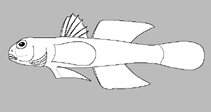
Épines dorsales (Total) : 7; Rayons mous dorsaux (Total) : 12; Épines anales: 1; Rayons mous anaux: 13. This species is distinguished by the following characters: Second dorsal-fin elements 13, anal-fin elements 14; teeth on upper jaw in a single row; fleshy tongue is rounded; upper lip is not constricted; without tentacle, callus, knob or spot posterodorsally on eye; anterior nares without a dark anteromedial spot; absence of spots on gular membrane beneath preopercle or anterior process of quadrate; without dark spots on scales of trunk; trunk possess 4 large rounded to elongate blotches along mid-side of body, with a small round to triangular blotch on caudal-fin base, some specimens with diffuse small brownish blotches visible, forming irregular rows ventral to, or interspersed with, mid-lateral blotches; on either side of dorsal midline are 2 irregular rows of spots, commencing on nape above opercle, upper row running along bases of fin rays, spots more distinct anteriorly; naked nape or scaled with naked median and low membranous crest; ctenoid scales on most of trunk then becoming cycloid anterior to second dorsal-fin origin; no scales on prepelvic area; lateral scales 61-79; spines of first dorsal fin are not produced, extending to about the third second dorsal-fin element; pectoral-fin rays 22-23; pelvic fins are dusky, with bars or mottled; a dark blotch on first dorsal fin behind or on both sides of sixth spine (Ref. 103856).
Body shape (shape guide): elongated; Cross section: compressed.
Cycle de vie et comportement reproducteur
Maturité | Reproduction | Frai | Œufs | Fécondité | Larves
Pezold, P.L. and H.K. Larson, 2015. A revision of the fish genus Oxyurichthys (Gobioidei: Gobiidae) with descriptions of four new species. Zootaxa 3988(1):1-95. (Ref. 103856)
Statut dans la liste rouge de l'IUCN (Ref. 130435: Version 2025-2 (Global))
Menace pour l'homme
Harmless
Utilisations par l'homme
Outils
Articles particuliers
Télécharger en XML
Sources Internet
Estimations basées sur des modèles
Indice de diversité phylogénétique (Réf.
82804): PD
50 = 0.5000 [Uniqueness, from 0.5 = low to 2.0 = high].
Bayesian length-weight: a=0.00708 (0.00332 - 0.01511), b=3.07 (2.89 - 3.25), in cm total length, based on LWR estimates for this (Sub)family-body shape (Ref.
93245).
Niveau trophique (Réf.
69278): 3.7 ±0.5 se; based on size and trophs of closest relatives
Résilience (Réf.
120179): Haut, temps minimum de doublement de population inférieur à 15 mois (Preliminary K or Fecundity.).
Vulnérabilité de la pêche (Ref.
59153): Low vulnerability (10 of 100).
🛈