การจำแนกประเภท / ชื่อ
ชื่อสามัญ | ชื่อพ้อง | Catalog of Fishes(สกุล, ชนิด) | ITIS | CoL | WoRMS | Cloffa
>
Synbranchiformes (Spiny eels) >
Synbranchidae (Swamp-eels)
Etymology: rongsaw: Name from the Khasi word meaning red, referring to the blood red colour of the species when alive; noun in apposition.
สิ่งแวดล้อม : สิ่งแวดล้อม / เขตภูมิอากาศ / ระดับความลึก / ระยะการกระจายสินค้า
นิเวศวิทยา
; น้ำจืด ผิวน้ำ; ระดับความลึก 0 - 1 m (Ref. 118582). Subtropical
Asia: Khasi Hills in Meghalaya, India.
ขนาด / น้ำหนัก / อายุ
วัยเจริญพันธุ์: Lm ? range ? - ? cm
Max length : 17.9 cm TL เพศผู้/กระเทย; (Ref. 118582)
คำอธิบายสั้นๆ
เครื่องมือที่ใช้ในการแยกชนิดสัตว์,สิ่งมีชีวิตออกจากกัน | สัณฐานวิทยา | ความยาวต่างๆ
สัตว์มีกระดูกสันหลัง: 161. This species is distinguished from all other synbranchids except Ophisternon infernale,
O. candidum, Monopterus boueti, M. luticolus, M. eapeni, M. roseni, and M. digressus in having tiny eyes which are covered by skin that are barely visible externally and by the lack of skin pigmentation. It differs from the seven species by having 92+69=161 vertebrae (vs. 67+72=139 in Ophisternon infernale, 51-54+109-111=162-163 in O. candidum, 108 + 79-86 = 187-194 in M. boueti, 95-102+98-110=198-208 in M. luticolus, 135+24=159 in M. eapeni, 76+71=147 in M. roseni, and 86-88+80-82=166-170 in M. digressus); differs further from M. boueti and M. luticolus in having the shoulder girdle articulating with the skull, with the posttemporal contacting the epiotic and supracleithrum (vs. cleithrum and supracleithrum posteriorly displaced and the posttemporal separated from the supracleithrum and epiotic) (Ref. 118582).
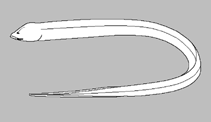
Body shape (shape guide): eel-like; Cross section: oval.
Obligate air-breathing (Ref. 126274); Collected by soil-digging searches with bladed hoes for fossorial caecilian amphibians; at a depth of ca. 40 cm in moist, rocky soil in a secondary forest, approximately 4 km trekking distance from Double Decker living roots bridge in Nongriat. It was unearthed ca. 50 m from an unnamed stream with some ground vegetation (herbs and bushes) that was cleared before digging (Ref. 118582).
วงจรชีวิตและพฤติกรรมการผสมพันธุ์
วัยเจริญพันธุ์ | การสืบพันธุ์ | การวางไข่ | เซลสืบพันธ์ของเพศเมีย(ไข่) | ความดกของไข่ | ตัวอ่อน
Britz, R., D. Sykes, D.J. Grower and R.G. Kamei, 2018. Monopterus rongsaw, a new species of hypogean swamp eel from the Khasi Hills in Northeast India (Teleostei: Synbranchiformes: Synbranchidae). Ichthyol. Explor. Freshwat. 28(4):315-326. (Ref. 118582)
สถานะบัญชีแดงของ IUCN (Ref. 130435: Version 2025-2 (Global))
ภัยคุกคามต่อมนุษย์
Harmless
การใช้ของมนุษย์
เครื่องมือ
รายงานพิเศษ
ดาวน์โหลด XML
แหล่งที่มาจากอินเตอร์เน็ต
การประมาณค่าตามแบบจำลอง
ดัชนีความหลากหลายทางวิวัฒนาการ (อ้างอิง
82804): PD
50 = 0.5312 [Uniqueness, from 0.5 = low to 2.0 = high].
Bayesian length-weight: a=0.00085 (0.00040 - 0.00182), b=3.09 (2.90 - 3.28), in cm total length, based on LWR estimates for this (Sub)family-body shape (Ref.
93245).
ระดับชั้นอาหาร (อ้างอิง
69278): 3.2 ±0.3 se; based on size and trophs of closest relatives
ความสามารถในการกลับคืนสู่ปกติ (อ้างอิง
120179): ความสูง, เวลาต่ำสุดที่จะทำให้ประชากรเพิ่มขึ้นเป็น 2 เท่าใช้เวลาน้อยกว่า 15 เดือน (Preliminary K or Fecundity.).
ความเสี่ยงต่อการตกปลา (Ref.
59153): Low vulnerability (10 of 100).
🛈