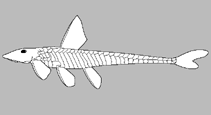
klasifikasi / Nama
Nama-nama umum | Sinonim (persamaan) | Catalog of Fishes(Marga, Jenis) | ITIS | CoL | WoRMS | Cloffa
>
Siluriformes (Catfishes) >
Loricariidae (Armored catfishes) > Hypoptopomatinae
Etymology: ephippia: The specific epithet ephippia (L. ephippium, Gr. ephippion means saddle) refers to the saddlelike
mid-dorsal blotches.
Lingkungan: lingkungan / zona iklim / kisaran kedalaman / jangkauan distribusi
Ekologi
; air tawar dasar (demersal). Tropical
South America: Essequibo and Branco basins in Guyana.
Ukuran / Berat / umur
Kematangan: Lm ? range ? - ? cm
Max length : 4.5 cm SL jantan/; (Ref. 110244)
deskripsi pendek
Kunci identifiaksi (pengenalan) | Morfologi | Morfometrik
duri punggung lunak (Keseluruhan (total)) : 7; Sirip dubur lunak: 6. Oxyropsis ephippia can be diagnosed from other congeners by the possessing a keel-like row of odontodes above the lateral-line canal on each median plate that is dominated by a single odontode (one closest to posterior margin of plate) conspicuously enlarged, typically one-third to one-half larger (along base-tip axis) than preceding one in same row (vs.keel-like row immediately above lateral-line with odontodes of roughly equal size). It further differs by having the sides of the trunk below the median series, approximately between plates 7 to 12, shielded by plates of the midventral series, with the exclusion of plates from the ventral series, which are visible only in ventral view of the trunk (vs. sides of the trunk shielded by plates of the midventral series and ventral series, the latter visible in lateral and ventral views of the trunk). It is also distinct from other congeners by its trunk median series with 23 plates (vs. 18-19 in O. acutirostra and 25-26 in O. carinata and O. wrightiana) and caudal peduncle in cross section slightly compressed at the level of the median plates 20-23 (vs. posterior caudal peduncle depressed); from O. acutirostra by having median series of plates complete (vs. series incomplete); from both O. acutirostra and O. wrightiana by having a deeper caudal peduncle (mean depth 4.8% SL vs. 2.9% and 2.0%, respectively), and shorter caudal peduncle (mean length 36.0% SL vs. 42.4% and 44.4%, respectively); and from O. carinata by possessing a larger eye (mean orbital diameter 18.2% HL vs. 15.7% HL) (Ref. 110244).
Body shape (shape guide): elongated.
Found in small to medium-sized streams with moderate current and riparian forest, water ranges from moderately turbid (e.g., Essequibo mainstem), to clear (Yuora), to black (Burro Burro). Most of the collecting localities are composed of a variety of substrates with sand being particularly common (Ref. 110244).
Siklus hidup dan perilaku kawin
Kematangan | Reproduksi, perkembang biakan | Pemijahan | telur-telur | Fekunditas | Larva
Aquino, A.E. and M.H. Sabaj Pérez, 2016. Oxyropsis ephippia, a new Hypoptopomatine catfish (Siluriformes: Loricariidae) from Guyana. Zootaxa 4136(1):129-140. (Ref. 110244)
Status IUCN Red List (Ref. 130435: Version 2025-2 (Global))
ancaman kepada manusia
Harmless
penggunaan manusia
Alat, peralatan
laporan khas
muat turun XML
Sumber internet
Estimasi berdasarkan model
Indeks keanekaragaman filogenetik (Acuan
82804): PD
50 = 0.7500 [Uniqueness, from 0.5 = low to 2.0 = high].
Bayesian length-weight: a=0.00977 (0.00434 - 0.02202), b=3.06 (2.87 - 3.25), in cm total length, based on LWR estimates for this (Sub)family-body shape (Ref.
93245).
Daya lenting (Acuan
120179): Tinggi, Waktu penggandaan populasi minimum kurang dari 15 bulan (Preliminary K or Fecundity.).
Kerentanan Penangkapan Ikan (Ref.
59153): Low vulnerability (10 of 100).
🛈