>
Cypriniformes (Carps) >
Cobitidae (Spined loaches)
Etymology: Cobitis: Greek, kobitis, -idos = a kind of sardine; also related with the voice Greek, kobios, Latin gobius = gudgeon (Ref. 45335); sakahoko: The specific epithet is derived from the legendary weapon Ama-no-sakahoko, meaning inverted halberd of heaven, which was thrust into the Takachiho Peak of Mt. Kirishima, one of the sources of the Takazaki River, the type locality of this new species. The lamina circularis of this species is a distinctive rectangular plate that
resembles a halberd.
Môi trường: môi trường / vùng khí hậu / Mức độ sâu / phạm vi phân phối
Sinh thái học
; nước ngọt sống nổi và đáy. Subtropical
Asia: Oyodo River system, Kyushu Island, Japan.
Bộ gần gũi / Khối lượng (Trọng lượng) / Tuổi
Chín muồi sinh dục: Lm ? range ? - ? cm
Max length : 7.3 cm SL con đực/không giới tính; (Ref. 117925); 8.9 cm SL (female)
Mô tả ngắn gọn
Khóa để định loại | Hình thái học | Sinh trắc học
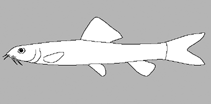
Các vây lưng mềm (tổng cộng) : 10; Tia mềm vây hậu môn: 8 - 9; Động vật có xương sống: 41 - 42. Cobitis sakahoko can be diagnosed from its congeners from Japan by the combination of the following characters: lamina circularis at the base of the pectoral fin in adult males, rectangular plate with a neck in the mid-lower part (vs. beak shape or narrow in C. biwae; roundish in C. magnostriata, C. striata, C. minamorii, C. kaibarai and C. matsubarae; ambiguous inC. takatsuensis and C. shikokuensis); broad upper segments of the first branched soft ray (vs. narrow in C. striata, C. minamorii, and C. kaibarai); maxillary barbel length longer than the eye diameter (vs. same as the eye diameter in C. magnostriata, C. striata, C. minamorii and C. kaibarai); 14 segmented muscle plates between the base of the pectoral fin and the origin of the pelvic fin (vs. usually 13 in C. striata and C. kaibarai; usually 12 in C. minamorii); snout rather short, about 35% in HL (vs. rather long, ca. 40% in C. biwae, C. minamorii and C. matsubarae; long, over ca. 40% in C. magnostriata, C. striata, C, kaibarai, C. takatsuensis and C. shikokuensis); body pigmentation consisting of 1 mid-dorsal and 4 lateral rows of blotches with line L4 broad fine mesh-like line in adult females (vs. jagged or dotted line in C. biwae and C. matsubarae; jagged line in C. kaibarai; absent or irregular dotted line in C. magnostriata, C. takatsuensis and C. shikokuensis) and line L5 arranged into 8-13 oblong or ovoid blotches in both males and females (vs. striated in C. magnostriata; marbled streak in C. takatsuensis); upper spot at caudal-fin base jet black and size greater than the eye diameter (vs. comparable to the eye diameter in C. striata, C. kaibarai and C. takatsuensis; smaller than the eye diameter in C. minamorii and C. shikokuensis); lower spot at caudal-fin base black and size comparable or smaller than the upper spot (vs. ambiguous in C. striata, C. kaibarai, C. takatsuensis and C. shikokuensis). Cobitis sakahoko can be distinguishable based on the mtDNA cytb sequences (Ref. 117925).
Body shape (shape guide): elongated.
Occurs in the middle reaches of rivers with sandy bottom (Ref. 117925).
Vòng đời và hành vi giao phối
Chín muồi sinh dục | Sự tái sinh sản | Đẻ trứng | Các trứng | Sự sinh sản | Ấu trùng
Nakajima, J. and Y. Suzawa, 2016. Cobitis sakahoko, a new species of spined loach (Cypriniformes: Cobitidae) from southern Kyushu Island, Japan. Ichthyol. Res. 63:68-78. (Ref. 117925)
Tình trạng Sách đỏ IUCN (Ref. 130435: Version 2025-2 (Global))
Mối đe dọa đối với con người
Harmless
Sử dụng của con người
Các công cụ
Báo cáo đặc biệt
Tải xuống XML
Các nguồn internet
Ước tính dựa trên mô hình
Chỉ số đa dạng phát sinh loài (Tài liệu tham khảo
82804): PD
50 = 0.5000 [Uniqueness, from 0.5 = low to 2.0 = high].
Bayesian length-weight: a=0.00513 (0.00231 - 0.01140), b=3.09 (2.92 - 3.26), in cm total length, based on LWR estimates for this Genus-body shape (Ref.
93245).
Mức dinh dưỡng (Tài liệu tham khảo
69278): 3.2 ±0.4 se; based on size and trophs of closest relatives
Thích nghi nhanh (Tài liệu tham khảo
120179): Chiêù cao, thời gian nhân đôi của chủng quần tối thiểu là dưới 15 tháng (Preliminary K or Fecundity.).
Sự dễ bị tổn thương của nghề đánh cá (Ref.
59153): Low vulnerability (10 of 100).
🛈