分類 / 名稱
俗名 | 同種異名 | Catalog of Fishes(屬, 種) | ITIS | CoL | WoRMS | Cloffa
Teleostei >
Siluriformes (Catfishes)
鯰形目 (Catfishes) >
Loricariidae (Armored catfishes)
甲鯰科 (Armored catfishes) > Hypostominae
Etymology: raso: The specific name raso,/i> is used in reference to the type locality, the igarapé Balneário Raso, a tributary of the rio Amapá, Atlantic coastal drainage. A noun in apposition.
環境: 環境 / 氣候帶 / 深度上下限 / 配送範圍
生態學
; 淡水 居於水底的.
分布
領土 | FAO區域 | 生態系 | 發現紀錄 | 分布圖 | 簡介 | Faunafri
South America: Rio Raso, rio Amapá basin in Brazil.
大小 / 重量 / 年齡
成熟度: Lm ? range ? - ? cm
Max length : 4.6 cm SL 雄魚/尚未辨別雌雄; (Ref. 118148)
簡短描述
檢索表 | 型態特徵 | 形態測量圖
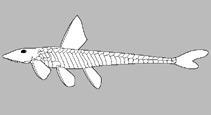
背棘 (總數) : 2; 背的軟條 (總數) : 7; 臀棘: 1; 臀鰭軟條: 5. Lithoxus raso is distinguished from all its congeners, with the exception of L. pallidimaculatus, by having large light spots all over the body, spots similar in size with orbit diameter, (vs. light spots over the body absent or light spots very small, similar to size of a tooth, covering only the dorsal portion of the head in L. boujardi); from L. surinamensis and L. pallidimaculatus by possessing an adipose fin (vs. adipose fin absent); from L. lithoides and L. jantjae by having five branched rays in the anal fin (vs. four); and from L. jantjae by having 14 branched rays in the caudal fin (vs. 12). In addition, Lithoxus raso is distinct from L. bovallii by having a lower premaxillary tooth cup length, 3.3-4.0% HL (vs. 4.2-10.4% HL); from L. boujardi by having a greater adipose-spine length, 7.2-8.1% SL (vs. 3.6-4.7% SL), and a greater dorsal adipose-caudal distance, 13.1-14.6% SL (vs. 10.3-11.7% SL); from L. planquettei by smaller caudal peduncle depth, 8.4- 8.6% SL (vs. 9.7-10.5% SL); and from L. stocki by having an enlarged and widened cusp of medial premaxillary teeth (vs. cusps of all premaxillary teeth similar in size, not enlarged), and by having a shorter cleithral width, 30.9-31.2% SL (vs. 32.6-34.2% SL) (Ref. 118148).
Body shape (shape guide): elongated.
Facultative air-breathing in the genus (Ref. 126274); Inhabits small- to medium-sized rivers with rocks and sand on the bottom (Ref. 118148).
生命週期和交配行為
成熟度 | 繁殖 | 產卵場 | 卵 | 孕卵數 | 仔魚
Silva, G.S.C., R. Covain, C. Oliveira and F.F. Roxo, 2017. Description of two new species of Lithoxus (Hypostominae: Loricariidae) from rio Jari and rio Amapá basins, Brazillian Guiana shield. Zootaxa 4347(1):151-168. (Ref. 118148)
IUCN 瀕危狀態 (Ref. 130435: Version 2025-2 (Global))
人類使用
工具
特別的報告
下載 XML
網路資源
基於模型的估計
系統發育多樣性指數 (參考文獻
82804): PD
50 = 0.5039 [Uniqueness, from 0.5 = low to 2.0 = high].
Bayesian length-weight: a=0.01549 (0.00726 - 0.03306), b=2.96 (2.79 - 3.13), in cm total length, based on LWR estimates for this (Sub)family-body shape (Ref.
93245).
回復力 (參考文獻
120179): 高度, 族群倍增時間少於 15個月 (Preliminary K or Fecundity.).
釣魚的脆弱性 (Ref.
59153): Low vulnerability (10 of 100).
🛈