Classificação / Nomes
Nomes comuns | Sinônimos | Catalog of Fishes(Gênero, Espécies) | ITIS | CoL | WoRMS | Cloffa
>
Cyprinodontiformes (Rivulines, killifishes and live bearers) >
Rivulidae (Rivulines) > Cynolebiinae
Etymology: Garcialebias: Named for Dr Graciela García and the Greek, 'lebias'; pelotapes: The name pelotapes is the old usage for the town of Pelotas, from the Spanish pelota, meaning ball, in referring to a little boat made in cow hide, and tapes, referring to the indigenous tribe inhabiting the area occupied in the past by the new species.
Meio ambiente: milieu / Zona climática / intervalo de profundidade / faixa de distribuição
Ecologia
; Água doce bentopelágico. Tropical
South America: stream drainages to the northern margin of the Canal de São Gonçalo, Patos-Mirim lagoon system, Rio Grande do Sul, Brazil.
Tamanho / Peso / Idade
Maturidade: Lm ? range ? - ? cm
Max length : 3.1 cm SL macho/indeterminado; (Ref. 118050); 2.9 cm SL (female)
Descrição suscinta
Chaves de identificação | Morfologia | Morfometria
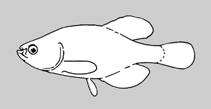
Austrolebias pelotapes can be diagnosed from all members of the A. adloffi group by having the urogenital papilla base attached by a thin membrane to the anterior margin of the anal fin in males (vs. urogenital papilla free). It differs from all other species of theA. adloffi group with the exception of A. pongondo, by having a transverse row of small spots on the middle portion of the dorsal fin in males (vs. transverse row absent), unpaired fins with a single row of light blue spots on their basal portion in males, and with distinctive dark grey zone on the posterior portion of the dorsal and anal fins (vs. multiple rows of blue dots and distinctive dark grey zone absent in A. charrua and A. minuano), and caudal peduncle mostly dark brownish grey or dark grey to black, with narrow vertical light blue zones in males (vs. alternating dark grey and light blue bars, dark grey bars slightly wider, equal or narrower than light blue bars, in A. adloffi, A. nachtigalli, A. nigrofasciatus, A. reicherti). It is distinguished from A. pongondo by having 14-19 neuromasts in the supraorbital series (vs. 20-21) and 22-23 neuromasts around orbit (vs. 24-27), and also color pattern in live males with grey bars on the flank barely contrasting with the light blue color ground (vs. dark grey to black bars in deep contrast to light blue interspace in A. pongondo) and lack of a row of blue dots on the basal portion of the caudal fin (vs. presence) (Ref. 118050).
Body shape (shape guide): elongated.
Ciclo de vida ou comportamento de acasalamento
Maturidade | Reprodução | Desova | Ovos | Fecundidade | Larvas
Costa, W.J.E.M., M.M. Cheffe and P.F. Amorim, 2017. Two new seasonal killifishes of the Austrolebias adloffi group from the Lagoa dos Patos basin, southern Brazil (Cyprinodontiformes: Aplocheilidae). Vertebrate Zoology 67(2):139-149. (Ref. 118050)
Status na Lista Vermelha da UICN (Ref. 130435: Version 2025-2 (Global))
Ameaça para os humanos
Harmless
Uso pelos humanos
Pescarias: sem interesse
Ferramentas
Relatórios especiais
Baixar XML
Fontes da internet
Estimativas baseadas em modelos
Índice de diversidade filogenética (Ref.
82804): PD
50 = 0.5000 [Uniqueness, from 0.5 = low to 2.0 = high].
Bayesian length-weight: a=0.00617 (0.00266 - 0.01427), b=3.13 (2.93 - 3.33), in cm total length, based on LWR estimates for this (Sub)family-body shape (Ref.
93245).
Nível Trófico (Ref.
69278): 3.1 ±0.4 se; based on size and trophs of closest relatives
Resiliência (Ref.
120179): Elevada, tempo mínimo de duplicação da população menor que 15 meses (Preliminary K or Fecundity.).
Vulnerabilidade da pesca (Ref.
59153): Low vulnerability (10 of 100).
🛈