>
Cyprinodontiformes (Rivulines, killifishes and live bearers) >
Rivulidae (Rivulines) > Cynolebiinae
Etymology: Cynolebias: Greek, kyon = dog + Greek, odous = teeth + Greek, lebias = a kind of small fish (Ref. 45335).
Môi trường: môi trường / vùng khí hậu / Mức độ sâu / phạm vi phân phối
Sinh thái học
; nước ngọt sống nổi và đáy. Tropical
South America: Verde Grande River drainage, Bahia, Brazil.
Bộ gần gũi / Khối lượng (Trọng lượng) / Tuổi
Chín muồi sinh dục: Lm ? range ? - ? cm
Max length : 3.8 cm SL con đực/không giới tính; (Ref. 118117); 3.7 cm SL (female)
Mô tả ngắn gọn
Khóa để định loại | Hình thái học | Sinh trắc học
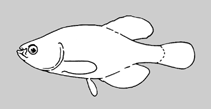
Cynolebias elegans is similar to other members of the C. gilbertoi group (C. gilbertoi and C. ochraceus) and distinguished from all other species of the subgenus Cynolebias, by having 19-16 vomerine teeth (vs. 1-4, when teeth are present), 7-8 gill-rakers on the ventral part of the first branchial arch (vs. 9-12), highest body depth at vertical just anterior to base of pelvic fin (vs. through base of pecto¬ral fin), and flank with light dots arranged in vertical groups (vs. light dots when present not arranged in vertical groups). It can be diagnosed from C. gil¬bertoi and C. ochraceus by possessing long dorsal and anal fins in males, their extremities excluding filaments posteri¬orly reaching base of caudal fin (vs. reaching caudal pedun¬cle), greater pre-pelvic length in males (52.2-53.9 % SL, vs. 48.5-49.9 % SL in C. gilbertoi and 48.9-50.5 % SL in C. ochraceus), and first proximal radial of the anal fin between neural spines of 9th and 10th vertebrae in males, and between neural spines of 11th and 12th vertebrae in females (vs. between neural spines of 11th and 13th verte¬brae in males, and between neural spines of 12th and 14th vertebrae in females). It can be further differentiated from C. gilbertoi by having the following characters: larger head (31.3-34.2 % SL in males, 32.1-33.4 % in females, vs. 27.9-30.3 % SL in males, 29.0-31.1 % in females) and smaller eye (25.5-29.1 % of head length in males, 27.3-29.9 % in fe¬males, vs. 30.0-31.0 % of head length in males, 31.5-34.2 % in females). It can be also distinguished from C. ochraceus by having 31-32 ver¬tebrae (vs. 33-34), narrower body depth (32.5-34.5 % SL vs. 35.0-37.8 % SL), and flank light pur¬plish brown in males (vs. light yellow ochre) (Ref. 118117).
Body shape (shape guide): fusiform / normal.
Vòng đời và hành vi giao phối
Chín muồi sinh dục | Sự tái sinh sản | Đẻ trứng | Các trứng | Sự sinh sản | Ấu trùng
Costa, W.J.E.M., 2017. Description of two endangered new seasonal killifish species of the genus Cynolebias from the São Francisco River basin, Brazilian Caatinga (Cyprinodontiformes, Aplocheilidae). Zoosyst. Evol. 93(2):333-341. (Ref. 118117)
Tình trạng Sách đỏ IUCN (Ref. 130435: Version 2025-2 (Global))
Mối đe dọa đối với con người
Harmless
Sử dụng của con người
Các công cụ
Báo cáo đặc biệt
Tải xuống XML
Các nguồn internet
Ước tính dựa trên mô hình
Chỉ số đa dạng phát sinh loài (Tài liệu tham khảo
82804): PD
50 = 0.5000 [Uniqueness, from 0.5 = low to 2.0 = high].
Bayesian length-weight: a=0.01122 (0.00514 - 0.02450), b=3.04 (2.87 - 3.21), in cm total length, based on all LWR estimates for this body shape (Ref.
93245).
Mức dinh dưỡng (Tài liệu tham khảo
69278): 3.2 ±0.4 se; based on size and trophs of closest relatives
Thích nghi nhanh (Tài liệu tham khảo
120179): Chiêù cao, thời gian nhân đôi của chủng quần tối thiểu là dưới 15 tháng (Preliminary K or Fecundity.).
Sự dễ bị tổn thương của nghề đánh cá (Ref.
59153): Low vulnerability (10 of 100).
🛈