>
Gobiiformes (Gobies) >
Gobiidae (Gobies) > Gobiinae
Etymology: Acentrogobius: Greek, a = without + Greek, kentron = sting + Latin gobius = gudgeon (Ref. 45335); vanderloosi: Named for Robert Vanderloos, owner and operator of the live-aboard dive vessel 'Chertan', and based at Alotau, Papua New Guinea.
Eponymy: Robert ‘Rob’ Van der Loos is the owner and operator of the live-aboard dive vessel ‘Chertan’, based at Alotau, Papua New Guinea. [...] (Ref. 128868), visit book page.
البيئة: الوسط / المنطقة المناخية / نطاق العمق / نطاق التوزيع
البيئة
بحري القاع; نطاق العمق 15 - 18 m (Ref. 100513). Tropical
Western Pacific: Papua New Guinea, but most probably ranges widely within the Indo-Australian Archipelago.
الحجم / وزن / العمر
النضج: Lm ? range ? - ? cm
Max length : 4.8 cm SL ذكر/ مختلط الجنس; (Ref. 100513); 4.5 cm SL (female)
وصف مختصر
مفاتيح التعريف | الوصف الخارجي | قياسات المظهر الخارجي
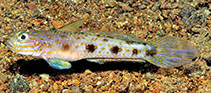
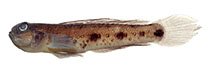
This species is distinguished by the following characters: D VI + I,10, dorsal spines thin and flexible, first two with long filamentous tips, that of second spine longest 2.3-3.2 in SL, reaching to base of about sixth soft ray of second dorsal fin when laid back; A I,10; pectoral-fin rays 20; lanceolate caudal fin which is slightly longer than head length in adult; scales 30 in longitudinal series; 9-10 transverse-scales; 12-13 predorsal-scales; finely ctenoid scales cover the body, becoming cycloid on the breast, pectoral-fin base, nape, and head; 3 scale rows on uppermost portion of opercle; cheek fully scaled; colour in life pale grey with numerous widely scattered dark-edged, orange spots on body, 5 horizontally-elongate dark brown blotches on side of body at level of pectoral-fin base, (including one at middle of caudal-fin base), a pair of orange stripes on cheek (Ref. 100513).
Body shape (shape guide): elongated; Cross section: compressed.
The collection area consists of moderately sloped (about 20 degrees) mud substratum (the slope begins in approximately 1.5 m depth and flattens out at about 18 m). The featureless bottom has numerous burrows occupied by a variety of fishes and invertebrates, including Acentrogobius vanderloosi. About eight individuals were observed on the lower section of the slope (15-18 m ) and only widely scattered, solitary individuals were seen, each of which was invariably associated with a muddy burrow, into which it retreated when approached (Ref. 100513).
دورة الحياة وسلوك التزاوج
النضج | التكاثر | وضع البيض | بيض | الخصوبة | اليرقات
Allen, G.R., 2015. Descriptions of two new gobies (Gobiidae: Acentrogobius) from Milne Bay Province, Papua New Guinea. J. Ocean Sci. Found. 14:1-13. (Ref. 100513)
حالة القائمة الحمراء للاتحاد الدولي لحفظ الطبيعة والموارد الطبيعية (Ref. 130435: Version 2025-2 (Global))
استخدامات بشرية
أدوات
تقارير خاصة
تنزيل XML
مصادر علي الأنترنت
تقديرات تستند إلى النماذج
مؤشر التنوع الشُعبي الوراثي (مرجع
82804): PD
50 = 0.5000 [Uniqueness, from 0.5 = low to 2.0 = high].
Bayesian length-weight: a=0.00794 (0.00340 - 0.01856), b=3.09 (2.91 - 3.27), in cm total length, based on LWR estimates for this Genus-body shape (Ref.
93245).
مستوى غذائي (مرجع
69278): 3.2 ±0.4 se; based on size and trophs of closest relatives
المرونه (مرجع
120179): عالي, الحد الزمني الأدني لتضاعف عدد أفراد المجتمع أقل من 15 شهر (Preliminary K or Fecundity.).
ضعف الصيد (Ref.
59153): Low vulnerability (10 of 100).
🛈