Clasificación / Nombres
Nombres comunes | Sinónimos | Catalog of Fishes(Género, Especie) | ITIS | CoL | WoRMS | Cloffa
>
Gobiiformes (Gobies) >
Gobiidae (Gobies) > Sicydiinae
Etymology: Lentipes: Latin, lens, lentis = slow + Latin, pes = foot (Ref. 45335); kolobangara: Named for the Kolobangara Island, where most of the specimens were caught. Kolobangara refers also , in Kolobangara Island dialect, to 'water king' which is suited for this colourful species.
Entorno: milieu / zona climática / rango de profundidad / gama de distribución
Ecología
; agua dulce demersal. Tropical
Oceania: Choiseul, Kolobangara, Ranongga, and Makira in Solomon Islands.
Tamaño / Peso / Edad
Madurez: Lm ? range ? - ? cm
Max length : 2.5 cm SL macho / no sexado; (Ref. 109045); 3.3 cm SL (female)
Descripción breve
Claves de identificación | Morfología | Morfometría
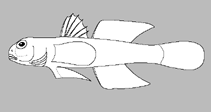
Espinas dorsales (total) : 7; Radios blandos dorsales (total) : 10; Espinas anales: 1; Radios blandos anales: 9 - 10. Lentipes kolobangara can be diagnosed by the following characters: pectoral fin with 17-18 rays; second dorsal fin I10; anal fin I9-10; and 7-9 scales in zigzag, 1-6 scales in transverse forward and 4-8 scales in transverse back series; and urogenital papilla retractable into a sheath-like groove in male and is without lobes or other expanded tissue. Male has few tricuspid teeth in the upper jaw (8-15) and 2-5 recurved canines posterior to tricuspid teeth, ctenoid scales on anterior body region strongly ossified, the base of the first dorsal fin not reaching the base of the second dorsal fin origin; and specific body colour with a red slim mustache on the snout reaching the eye and the base of the pectoral fins and the first third of their membrane are red (Ref. 109045).
Body shape (shape guide): elongated.
Inhabits swift, clear, high-gradient streams with a rocky and boulder-strewn bottom between 50 and more than 600 m above sea level (Ref. 109045).
Ciclo vital y comportamiento de apareamiento
Madurez | Reproducción | Puesta | Huevos | Fecundidad | Larva
Keith, P., C. Lord, D. Boseto and B.C. Ebner, 2016. A new species of Lentipes (Gobiidae) from the Solomon Islands. Cybium 40(2):139-146. (Ref. 109045)
Situación en la Lista Roja de la UICN (Ref. 130435: Version 2025-2 (Global))
Amenaza para el ser humano
Harmless
Usos humanos
Herramientas
Informes especiales
Descargar XML
Fuentes de Internet
Estimaciones basadas en modelos
Índice de diversidad filogenética (Referencia
82804): PD
50 = 0.5000 [Uniqueness, from 0.5 = low to 2.0 = high].
Bayesian length-weight: a=0.00389 (0.00180 - 0.00842), b=3.12 (2.94 - 3.30), in cm total length, based on all LWR estimates for this body shape (Ref.
93245).
Resiliencia (Referencia
120179): Alto, población duplicada en un tiempo mínimo inferior a 15 meses (Preliminary K or Fecundity.).
Vulnerabilidad pesquera (Ref.
59153): Low vulnerability (10 of 100).
🛈