Klassifizierung / Names
Namen | Synonyme | Catalog of Fishes(Gattung, Arten) | ITIS | CoL | WoRMS | Cloffa
>
Eupercaria/misc (Various families in series Eupercaria) >
Labridae (Wrasses) > Cirrhilabrinae
Etymology: Cirrhilabrus: Latin, cirrus = curl fringe + Greek, labros = furious (Ref. 45335); squirei: Named for Lyle Squire of Cairns Marine.
Eponymy: Lyle Squire is the brother of Cadel (above) with whom he runs ‘Cairns Marine’, an Australian company exporting marine fauna. (Ref. 128868), visit book page.
Umwelt: Milieu / Klimazone / Tiefenbereich / Verbreitungsgebiet
Ökologie
seewasser riff-verbunden; tiefenbereich 28 - 65 m (Ref. 118208). Tropical
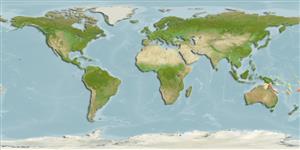
Western Pacific: Australia.
Größe / Gewicht / Alter
Geschlechtsreife: Lm ? range ? - ? cm
Max length : 5.6 cm SL Männchen/unbestimmt; (Ref. 118208)
Kurzbeschreibung
Bestimmungsschlüssel | Morphologie | Morphometrie
Rückenflossenstacheln (insgesamt) : 11; Rückenflossenweichstrahlen (insgesamt) : 9; Afterflossenstacheln: 3; Afterflossenweichstrahlen: 9; Wirbelzahl: 25. This species is distinguished by the following characters: D XI,9 (a female paratype with XII,9); A III,9; pectoral rays 15; lateral line scales 17+7; median predorsal scales 5; horizontal rows of scales on cheek 2; gill rakers 13-15; body depth 2.85-3.40 in SL, width 1.95-2.15 in body depth; head length 2.75-2.90 in SL; snout length 4.1-4.4 in HL; short pelvic fin, not reaching base of the anal fin, 4.15-4.65 in SL; rounded to truncate caudal fin in females and moderately to strongly lunate in males, caudal concavity as great as 0.8 in head; large eye, orbit diameter 3.55-3.90 in HL; colour in life with body yellow shading yellow white on abdomen, 5 irregular red orange bands, yellow dorsal fin with spinous portion having dusky spots on outer part, black on the first membrane, a central lavender band becoming black toward soft rays and soft portion with a black central band abruptly translucent posteriorly, the anal fin yellow, soft portion with a broad lavender black central band becoming narrower on the spinous part, the caudal fin yellow with 7 dusky black tongue-shaped extensions on the innermost rays; colour when preserved, males pale yellow and bands mentioned above on dorsal, anal and caudal fins are dusky to black, paired fins translucent (Ref. 118208).
Body shape (shape guide): fusiform / normal; Cross section: compressed.
Lebenszyklus und Paarungsverhalten
Geschlechtsreife | Fortpflanzung | Ablaichen | Eier | Fruchtbarkeit | Larven
Walsh, F.M., 2014. Cirrhilabrus squirei, a new wrasse (Perciformes; Labridae) from the Great Barrier Reef and Coral Sea, Australia. aqua, Int. J. Ichthyol. 20(3): 123-130. (Ref. 118208)
IUCN Rote Liste Status (Ref. 130435: Version 2025-2 (Global))
Bedrohung für Menschen
Harmless
Nutzung durch Menschen
Tools
Zusatzinformationen
Download XML
Internet Quellen
Schätzungen auf der Grundlage von Modellen
Phylogenetischer Diversitätsindex (Ref.
82804): PD
50 = 0.5000 [Uniqueness, from 0.5 = low to 2.0 = high].
Bayesian length-weight: a=0.01072 (0.00427 - 0.02691), b=3.03 (2.81 - 3.25), in cm total length, based on LWR estimates for this (Sub)family-body shape (Ref.
93245).
Trophische Ebene (Ref.
69278): 3.3 ±0.4 se; based on size and trophs of closest relatives
Widerstandsfähigkeit (Ref.
120179): hoch, Verdopplung der Population dauert weniger als 15 Monate. (Preliminary K or Fecundity.).
Anfälligkeit der Fischerei (Ref.
59153): Low vulnerability (10 of 100).
🛈