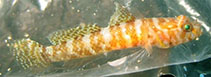
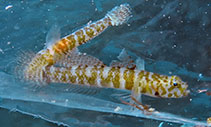
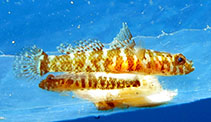
Classificatie / Namen
Lokale namen | Synoniemen | Catalog of Fishes(Genus, Soort(en)) | ITIS | CoL | WoRMS | Cloffa
>
Gobiiformes (Gobies) >
Gobiidae (Gobies) > Gobiinae
Etymology: Marcelogobius: Named after Marcelo Kovačić, who is the leading active goby expert for the Eastern Atlantic, Mediterranean and Ponto-Caspian region; janetarum: Named for Mrs. Janet Camp and Ms. Janet Eyre, who generously supported our goby research; noun in feminine genitive (plural).
Eponymy: Janet Van Sickle Eyre (d: 1955), along with Janet Camp (both of Reef Environmental Education Foundation), gave generous support to the authors’ goby research. (See Eyre) (Ref. 128868), visit book page.
Milieu: milieu / Klimaatzone / Diepte / verspreidingsgebied
Ecologie
marien rifbewoner; diepte 12 - 20 m (Ref. 118256). Tropical
Eastern Central Atlantic: Republic of Cabo Verde.
Grootte / Gewicht / Leeftijd
Maturiteit: Lm ? range ? - ? cm
Max length : 2.6 cm SL mannelijk / geslacht onbekend; (Ref. 118256)
Korte beschrijving
Determinatiesleutels | Morfologie | Morfometrie
Dorsale stekels (totaal) : 7; Dorsale zachte stralen (totaal) : 10; Anale stekels: 1; Anale zachte stralen: 9; Wervels: 27. This species is distinguished from its congeners by the following set of characters: vertebrae 27; D2 I,10; scaled posterior quarter of the predorsal region in front of D1 origin and with several rows of cycloid scales; scales on body, cycloid anteriorly and ctenoid posteriorly; scales in lateral series 30-32, with anterior oculoscapular canal; absence of preopercular head canal; suborbital row 7 each a single papilla, suborbital rows 2 and 4 are close to orbit; branchiostegal membranes are uniformly black below preopercle, forming V-mark (Ref. 118256).
Body shape (shape guide): fusiform / normal; Cross section: oval.
Collected exclusively from small caves and rock crevices with a specimen observed lurking out of a small cave before it was collected, whereas the other four known specimens were retrieved after spraying clove oil (a fish anesthetic) into rock crevices on vertical walls covered with the coral Tubastrea caboverdiana (Ref. 118256).
Levenscyclus en paargedrag
Maturiteit | Voortplanting | Paaien | Eieren | Fecunditeit | Larven
Schliewen, U.K., P. Wirtz and M. Kovačić, 2018. Didogobius janetarum sp. nov., a new cryptobenthic goby species from the Cape Verde Islands (Teleostei: Gobiidae). Zootaxa 4438(2):381-393. (Ref. 118256)
Status op de Rode Lijst van het IUCN (Ref. 130435: Version 2025-2 (Global))
Gevaar voor de mens
Harmless
Gebruik door de mens
Tools
Speciale rapporten
Download XML
Internetbronnen
Schattingen op basis van modellen
Fylogenetische diversiteitsindex (Ref.
82804): PD
50 = 0.6250 [Uniqueness, from 0.5 = low to 2.0 = high].
Bayesian length-weight: a=0.01023 (0.00477 - 0.02194), b=3.01 (2.83 - 3.19), in cm total length, based on LWR estimates for this (Sub)family-body shape (Ref.
93245).
Trofisch niveau (Ref.
69278): 3.1 ±0.3 se; based on size and trophs of closest relatives
Weerstandsvermogen (Ref.
120179): Hoog, minimale populatieverdubbelingstijd minder dan 15 maanden (Preliminary K or Fecundity.).
Kwetsbaarheid van de visserij (Ref.
59153): Low vulnerability (10 of 100).
🛈