>
Eupercaria/misc (Various families in series Eupercaria) >
Labridae (Wrasses) > Cirrhilabrinae
Etymology: Cirrhilabrus: Latin, cirrus = curl fringe + Greek, labros = furious (Ref. 45335); africanus: Named for the continent of Africa; noun in apposition.
Ambiente: milieu / zona climatica / distribuzione batimetrica / gamma di distribuzione
Ecologia
marino associati a barriera corallina; distribuzione batimetrica 18 - 50 m (Ref. 114940). Tropical
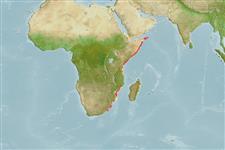
Western Indian Ocean: Kenya and most probably in South Africa and Mozambique.
Dimensione / Peso / Età
Maturità: Lm ? range ? - ? cm
Max length : 6.5 cm SL maschio/sesso non determinato; (Ref. 114940); 4.4 cm SL (female)
Breve descrizione
Chiavi di identificazione | Morfologia | Morfometria
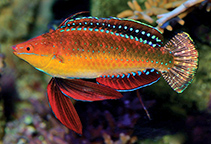
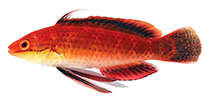
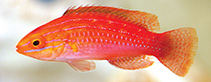
Spine dorsali (totale) : 11; Raggi dorsali molli (totale) : 9; Spine anali: 3; Raggi anali molli: 9. This species is distinguished by the following characters: D XI,9; A III,9; pectoral-fin rays 15; pored lateral-line scales 15-18 + 6-7 (+1 over caudal-fin base); median predorsal scales 3-4; cheek with 5-7 scales in single row below the eye; uniserial row of suborbital pores; gill rakers 14-16. Morphometrics for terminal males: body depth 3.2-3.8 in SL; body width in depth 1.8-1.9; head length 3.0-3.1 in SL; the first 2 dorsal-fin spinous membranes moderately elongated and filamentous, 3.7-4.3 and 5.4-7.7 in SL, respectively; rounded caudal fin without extended upper and lower tips, 1.1-1.3 in HL; pelvic fins greatly elongated and broadly fan-like, reaching posteriorly to about middle of anal fin, 2.1-2.3 in SL; upper head and body reddish orange, lower head and body yellow to white, about three rows of small, well-spaced, bluish-to-lavender or reddish spots (not a stripe) across upper body; dorsal fin mostly dark to dusky red, divided mid-way out by a row of separated rounded spots (after first two membranes); caudal fin mostly dark with coppery-to-greenish sheen and numerous small pale spots and lines; the anal fin is mostly dark to dusky reddish; pelvic fins are greatly elongated and mostly dark to dusky reddish. (Ref. 114940).
Body shape (shape guide): fusiform / normal; Cross section: compressed.
Ciclo vitale e comportamento di accoppiamento
Maturità | Riproduzione | Deposizione | Uova | Fecondità | Larve
Victor, B.C., 2016. Two new species in the spike-fin-fairy-wrasse species complex (Teleostei: Labridae: Cirrhilabrus) from the Indian Ocean. J. Ocean Sci. Found. 23:21-50. (Ref. 114940)
Stato della Lista Rossa IUCN (Ref. 130435: Version 2025-2 (Global))
Minaccia per l'uomo
Harmless
Usi umani
Pesca: commerciale; Acquario: Commerciale
Strumenti
Rapporti speciali
Scarica XML
Fonti Internet
Stime basate su modelli
Indice di diversità filogenetica (Fonte Biblio.
82804): PD
50 = 0.5000 [Uniqueness, from 0.5 = low to 2.0 = high].
Bayesian length-weight: a=0.01072 (0.00427 - 0.02691), b=3.03 (2.81 - 3.25), in cm total length, based on LWR estimates for this (Sub)family-body shape (Ref.
93245).
Livello trofico (Fonte Biblio.
69278): 3.3 ±0.4 se; based on size and trophs of closest relatives
Resilienza (Fonte Biblio.
120179): Alto, tempo minimo di raddoppiamento della popolazione meno di 15 mesi (Preliminary K or Fecundity.).
Vulnerabilità della pesca (Ref.
59153): Low vulnerability (10 of 100).
🛈