分類 / 名稱
俗名 | 同種異名 | Catalog of Fishes(屬, 種) | ITIS | CoL | WoRMS | Cloffa
Teleostei >
Cyprinodontiformes (Rivulines, killifishes and live bearers)
鱂形目 (Rivulines, killifishes and live bearers) >
Goodeidae (Splitfins)
谷鱂科 (Splitfins) > Goodeinae
Etymology: Xenotoca: Greek, xenos = strange + Greek, tokos, oy = birth (Ref. 45335); doadrioi: Named for Dr. Ignacio Doadrio, Museo Nacional de Ciencias Naturales, Spain, who has strongly contributed to the study and knowledge of Mesoamerican fish diversity. An adjective.
Eponymy: Dr Ignacio Doadrio (d: 1957) is a Spanish ichthyologist at the National Museum of Natural Science. [...] (Ref. 128868), visit book page.
環境: 環境 / 氣候帶 / 深度上下限 / 配送範圍
生態學
; 淡水 底中水層性.
分布
領土 | FAO區域 | 生態系 | 發現紀錄 | 分布圖 | 簡介 | Faunafri
Central America: endemic to the endorheic region of Etzatlan in Jalisco, Mexico.
大小 / 重量 / 年齡
成熟度: Lm ? range ? - ? cm
Max length : 3.7 cm SL 雄魚/尚未辨別雌雄; (Ref. 117630); 4.7 cm SL (female)
簡短描述
檢索表 | 型態特徵 | 形態測量圖
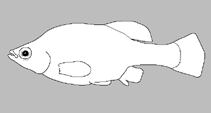
背的軟條 (總數) : 12 - 14; 臀鰭軟條: 13 - 15. Xenotoca doadrioi differs from other congeners of the Xenotoca eiseni group and other Xenotoca species occurring in the Pacific Coast drainages by the combination of the following characters (none unique to the species): females with 14 dorsal rays (vs. 15 or 16 in X. melanosoma and 13 in X. lyonsi), 14 anal fin rays (vs. 5 or 16 in X. melanosoma), 12 pectoral fin rays (vs. 13 in Xenotoca eiseni), 8 caudal peduncle scales (vs. 9 in Xenotoca eiseni and X. melanosoma), 32 scales in a lateral series (vs. 31 in Xenotoca lyonsi), and 10 suparorbital pores (vs. 9 in Xenotoca eiseni and X. lyonsi). Females of X. doadrioi have large caudal peduncle (standard length/end of the anal fin-hypural plate distance = 3.8, vs. 4.1-4.2 in X. eiseni and X. lyonsi) and SL/end of dorsal fin-hypural plate distance = 3.6 (vs. 3.9-4.2 in X. eiseni and X. lyonsi), large eye (Head length/Eye Diameter = 3, vs. 3.5-3.7 in X. eiseni and X. lyonsi). Males possess 14 dorsal rays (vs. 15 or 16 in X. melanosoma and 13 in X. lyonsi), 14 anal fin rays (vs. 15 or 16 in X. melanosoma), 12 pectoral rays (vs. 13 in Xenotoca eiseni), 8 caudal peduncle scales (vs. 9 in Xenotoca eiseni and X. melanosoma), 11 transversal scales (vs. 9 in X. lyonsi), 32 scales in a lateral series (vs. 31 in Xenotoca lyonsi) and 10 suprorbital pores (vs. 9 in Xenotoca eiseni and X. lyonsi). It has a smaller head (Head Length/Head High = 1.4, vs. 1.1-1.2 in Xenotoca eiseni and X. lyonsi), the body is less high (Standard Length/pelvic-pectoral fin distance = 4.7 vs. 4-4.4 in Xenotoca eiseni and X. lyonsi) and large caudal peduncle (Standard length/ end of the anal fin-hypural plate distance = 3.8 vs. 4-4.2 in Xenotoca eiseni and X. lyonsi), and standard length /end of dorsal fin-hypural plate distance 3.8 (vs. 4.1-4.3 in Xenotoca eiseni and X. lyonsi) (Ref. 117630).
Body shape (shape guide): fusiform / normal.
This species occurs in permanent pond, spring, reservoir, and seasonally affected streams. The type locality is a permanent pond where this species inhabits an area with turbid and shallow water of no more than 1.5 m deep and with bottom comprising of mud and gravel and no water plants present. Other fishes collected in the area are the following: Xenotoca melanosoma, Goodea atripinnis, Poeciliopsis infans, and the introduced Xiphophorus variatus and Oreochromis sp.. In the El Moloya Spring, this species inhabits clear water with gravel to muddy bottom and water plants. The following species are found in this pond: X. melanosoma, Zoogoneticus purepechus, Ameca splendens, G. atripinnis, P. infans, and the introduced Oreochromis sp. In Oconahua Dam, this species live in turbid water with a muddy bottom and with few water plants. Other species occurring in this dam include the following: X. melanosoma, G. atripinnis, P. infans, as well as the introduced Lepomis macrochirus, and Cyprinus carpio. This species is also collected in a seasonally fluctuating stream (San Marcos stream) that is dry for most of the year, but when water is present the surface of the stream is totally cover with Eichhornia crassipes Martius, Thypa sp., and Cyperus sp. and the water at this site is highly polluted by organic matter and is turbid. This species is also found in Sahuaripa stream, an irrigation channel totally modified and fed by a water pump. Other species collected in San Marcos and Sahuaripa streams are X. melanosoma, Allotoca sp., G. atripinnis, P. infans, and Oreochromis sp. (Ref. 117630).
生命週期和交配行為
成熟度 | 繁殖 | 產卵場 | 卵 | 孕卵數 | 仔魚
Domínguez-Domínguez, O., D.M. Bernal-Zuñiga and K.R. Piller, 2016. Two new species of the genus Xenotoca Hubbs and Turner, 1939 (Teleostei; Goodeidae) from the central-western Mexico. Zootaxa 4189(1):81-98. (Ref. 117630)
IUCN 瀕危狀態 (Ref. 130435: Version 2025-2 (Global))
極危 (CR) (B1ab(i,ii,iii,iv)); Date assessed: 14 March 2017
人類使用
漁業: 沒有興趣
工具
特別的報告
下載 XML
網路資源
基於模型的估計
系統發育多樣性指數 (參考文獻
82804): PD
50 = 0.5312 [Uniqueness, from 0.5 = low to 2.0 = high].
Bayesian length-weight: a=0.01202 (0.00468 - 0.03088), b=3.01 (2.79 - 3.23), in cm total length, based on LWR estimates for this (Sub)family-body shape (Ref.
93245).
營養階層 (參考文獻
69278): 2.1 ±0.1 se; based on size and trophs of closest relatives
釣魚的脆弱性 (Ref.
59153): Low vulnerability (10 of 100).
🛈