Classificazione / Nomi
Nomi Comuni | Sinonimi | Catalog of Fishes(Genere, Specie) | ITIS | CoL | WoRMS | Cloffa
>
Siluriformes (Catfishes) >
Amblycipitidae (Torrent catfishes)
Etymology: Amblyceps: Greek, amblys = soft, darkness + Latin, ceps = head (Ref. 45335); waikhomi: Named for Waikhom Vishwanath for his outstanding contribution to freshwater ichthyology in the Indian subcontinent.
Eponymy: Dr Waikhom Vishwanath (d: 1954) is an Indian ichthyologist who is at the Department of Life Sciences, Manipur University, Canchipur, where he is Professor of Life Sciences. [...] (Ref. 128868), visit book page.
Ambiente: milieu / zona climatica / distribuzione batimetrica / gamma di distribuzione
Ecologia
; acqua dolce demersale; pH range: 6.8 - ?. Subtropical; 24°C - ? (Ref. 118109)
Asia: Nongkon stream draining to Noa Dehing River (Brahmaputra basin), Arunachal Pradesh, India.
Dimensione / Peso / Età
Maturità: Lm ? range ? - ? cm
Max length : 4.5 cm SL maschio/sesso non determinato; (Ref. 118109)
Breve descrizione
Chiavi di identificazione | Morfologia | Morfometria
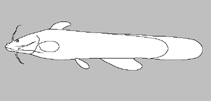
Spine dorsali (totale) : 1; Raggi dorsali molli (totale) : 6; Raggi anali molli: 13. Amblyceps waikhomi is diagnosed from all congeners in having a deeper body (depth at anus 17.0-20.3% SL vs. 7.6-16.9) and fewer total vertebrae (34-35 vs. 37-48), with exception of A. mangois and A. serratum). It can be differentiated from A. mangois by the absence (vs. presence) of strongly-developed projections on the proximal lepidotrichia of the median caudal-fin rays and by having a longer, wider, and deeper head (length: 22.-24.3% SL vs. 18.8-21.3, width: 20.0-21.9% SL vs. 17.1-18.3, depth: 13.9-18.0% SL vs. 11.6-13.2); and from A. serratum by having a posteriorly smooth (vs. with 4-5 serrations) pectoral spine, and unequal jaw length (lower jaw longer and weakly-projecting anteriorly vs. equal upper and lower jaws). It is also distinguished from A. murraystuarti, A. torrentis, A. apangi, A. laticeps, and A. cerinum by its deeply forked caudal fin (vs. emarginate or truncate) (Ref. 118109).
Body shape (shape guide): elongated.
Found in slow moving stream (water current 0.16 m/s) with a bottom substrate dominated by sand, occasionally associated with mud. Usually occurs under submerged logs and bamboo. The dominant macrophyte in the stream is water hyacinth. The following chemical parameters of the stream were recorded: DO 6.75 mg/l, DCO2 1.53 mg/l, alkalinity 66.06 mg/l, and hardness 71.8 ± 3.05 mg/l. The physical parameters of the stream were pH 6.78, air temperature 23.8 ±0.87°C, water temperature 23.5 ±0.96°C, transparency 79.5 ±1.93 cm, and conductivity 173.33 μS. (Ref. 118109).
Ciclo vitale e comportamento di accoppiamento
Maturità | Riproduzione | Deposizione | Uova | Fecondità | Larve
Darshan, A., A. Kachari, R. Dutta, A. Ganguly and D.N. Das, 2016. Amblycepswaikhomi, a new species of catfish (Siluriformes: Amblycipitidae) from the Brahmaputra Drainage of Arunachal Pradesh, India. PLoS ONE 11(2):e0147283. (Ref. 118109)
Stato della Lista Rossa IUCN (Ref. 130435: Version 2025-2 (Global))
Minaccia per l'uomo
Harmless
Usi umani
Strumenti
Rapporti speciali
Scarica XML
Fonti Internet
Stime basate su modelli
Indice di diversità filogenetica (Fonte Biblio.
82804): PD
50 = 0.5000 [Uniqueness, from 0.5 = low to 2.0 = high].
Bayesian length-weight: a=0.00661 (0.00312 - 0.01398), b=3.00 (2.82 - 3.18), in cm total length, based on LWR estimates for this (Sub)family-body shape (Ref.
93245).
Livello trofico (Fonte Biblio.
69278): 3.1 ±0.4 se; based on size and trophs of closest relatives
Vulnerabilità della pesca (Ref.
59153): Low vulnerability (10 of 100).
🛈