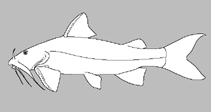
Classification / Noms
Noms communs | Synonymes | Catalog of Fishes(Genre, Espèce) | ITIS | CoL | WoRMS | Cloffa
>
Siluriformes (Catfishes) >
Sisoridae (Sisorid catfishes) > Sisorinae
Etymology: fucosa: Derived from the Latin adjective fucosus, meaning painted or colored, in reference to the color pattern of this species, which includes more pale spots and stripes than most congeners.
Environnement : milieu / zone climatique / profondeur / gamme de distribution
Écologie
; eau douce démersal. Tropical
Asia: Karnaphuli River drainage in Mizoram, India.
Taille / Poids / Âge
Maturité: Lm ? range ? - ? cm
Max length : 2.7 cm SL mâle / non sexé; (Ref. 107791)
Description synthétique
Clés d'identification | Morphologie | Morphométrie
Rayons mous dorsaux (Total) : 5; Rayons mous anaux: 10 - 11; Vertèbres: 29 - 30. Pseudolaguvia fucosa is distinguished from congeners except for P. virgulata by the presence (vs. absence) of a pale, y-shaped marking on the dorsal surface of the head; from congeners except for P. flavida, P. kapuri, P. muricata, P. nepalensis, P. ribeiroi and P. virgulata by the presence (vs. absence) of serrations on the anterior edge of the dorsal spine. It differs from the remaining six species by a combination of the following characters: dorsal-fin spine length 18.0-21.6% SL; anterior edge of the dorsal spine with 4-10 serrations; pectoral-fin spine length 20.7-26.1% SL; adipose-fin base length 21.5-26.3% SL; body depth at anus 12.3-15.9% SL; caudal peduncle depth 7.5-9.8% SL; caudal peduncle length 17.0-20.5% SL; and sides of body with pale yellowish patches and irregular bands (Ref. 107791).
The type locality, Tuichawng River, has a moderate current and a substrate composed of sand and pebble. Other fishes collected together with Pseudolaguvia fucosa include Amblyceps cf. mangois, Mystus bleekeri, and one or more species each of Psilorhynchus, Schistura, Physoschistura and Badis (Ref. 107791).
Cycle de vie et comportement reproducteur
Maturité | Reproduction | Frai | Œufs | Fécondité | Larves
Ng, H.H., L. Lalramliana and S. Lalronunga, 2016. A new diminutive sisorid catfish (Actinopterygii: Siluriformes) from northeastern India. Zootaxa 4105(6):546-556. (Ref. 107791)
Statut dans la liste rouge de l'IUCN (Ref. 130435: Version 2025-2 (Global))
Menace pour l'homme
Harmless
Utilisations par l'homme
Pêcheries: sans intérêt
Outils
Articles particuliers
Télécharger en XML
Sources Internet
Estimations basées sur des modèles
Indice de diversité phylogénétique (Réf.
82804): PD
50 = 0.5000 [Uniqueness, from 0.5 = low to 2.0 = high].
Bayesian length-weight: a=0.00676 (0.00310 - 0.01476), b=3.03 (2.85 - 3.21), in cm total length, based on LWR estimates for this (Sub)family-body shape (Ref.
93245).
Niveau trophique (Réf.
69278): 3.1 ±0.4 se; based on size and trophs of closest relatives
Résilience (Réf.
120179): Haut, temps minimum de doublement de population inférieur à 15 mois (Preliminary K or Fecundity.).
Vulnérabilité de la pêche (Ref.
59153): Low vulnerability (10 of 100).
🛈