>
Gobiiformes (Gobies) >
Gobiidae (Gobies) > Gobiinae
Etymology: Thorogobius: Greek, thoros = semen + Latin, gobius = gudgeon (Ref. 45335); alvheimi: Named for Oddgeir Alvheim of the Institute of Marine Research, Bergen, Norway.
Eponymy: These genera and species are named after ‘Thor’, the first Danish research vessel specifically equipped for oceanic scientific research (named after the Norse god of thunder). [...] Oddgeir Berg Alvheim (d: 1944) of the Institute of Marine Research in Norway. [...] (Ref. 128868), visit book page.
Meio ambiente: milieu / Zona climática / intervalo de profundidade / faixa de distribuição
Ecologia
marinhas pelagic-neritic; intervalo de profundidade 74 - 208 m (Ref. 118185). Deep-water
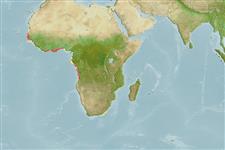
Eastern Atlantic: Angola and Ghana.
Tamanho / Peso / Idade
Maturidade: Lm ? range ? - ? cm
Max length : 10.2 cm SL macho/indeterminado; (Ref. 118185); 7.2 cm SL (female)
Descrição suscinta
Chaves de identificação | Morfologia | Morfometria
Espinhos dorsais (total) : 7; Raios dorsais (total) : 11; Espinhos anais: 1; Raios anais : 10; Vértebras: 28. This species is distinguished from its congeners by the following characters: D1 VI (second and third distinctly elongated), D2 I,11; pectoral fin rays 20-21; complete pelvic disc with short with well-developed anterior membrane (frenum), lateral lobes pointed; nape and predorsal area naked; no scales on the opercle; scales in longitudinal series 27-31; supratemporal rows tr and trp developed and extending transversally between pores H and K; longitudinal row g is short, not passing row m posteriorly and distinctly distant from row h; long infraorbital row 6, ventrally extending to lower margin of preopercle, its ventral section 6i originating anterior to its dorsal section 6s; posterior lateral row h reaching anteriorly above posterior third of opercle; body depth 16.6-20.4% at anal-fin origin in SL; head width 42.9-53.8% in head length; upper jaw long 42.6-45.7% in head length; minimum height of caudal peduncle 34.8-50.2% in caudal peduncle length; large eyes 22.4-31.3% in head length; short caudal fin 27.1-32.3% in SL; body is uniformly pale fawn and brown with margin of scale pockets dark brown pigmented, yielding a reticulated pattern; presence of pale spots on nape and predorsal area; caudal fin is uniformly dusky greyish (Ref. 118185).
Body shape (shape guide): elongated; Cross section: oval.
Specimens were dredged on the outer edge of the continental shelf and found on soft bottom (Ref. 118185).
Ciclo de vida ou comportamento de acasalamento
Maturidade | Reprodução | Desova | Ovos | Fecundidade | Larvas
Sauberer, M., T. Iwamoto and H. Ahnelt, 2018. Two new deep-water species of the genus Thorogobius (Teleostei: Gobiidae) from the upper continental slope of the Eastern Central Atlantic. Zootaxa 4429(2):357-371. (Ref. 118185)
Status na Lista Vermelha da UICN (Ref. 130435: Version 2025-2 (Global))
Ameaça para os humanos
Harmless
Uso pelos humanos
Ferramentas
Relatórios especiais
Baixar XML
Fontes da internet
Estimativas baseadas em modelos
Índice de diversidade filogenética (Ref.
82804): PD
50 = 0.5156 [Uniqueness, from 0.5 = low to 2.0 = high].
Bayesian length-weight: a=0.00741 (0.00347 - 0.01582), b=3.09 (2.91 - 3.27), in cm total length, based on LWR estimates for this (Sub)family-body shape (Ref.
93245).
Nível Trófico (Ref.
69278): 3.4 ±0.4 se; based on size and trophs of closest relatives
Resiliência (Ref.
120179): Elevada, tempo mínimo de duplicação da população menor que 15 meses (Preliminary K or Fecundity.).
Vulnerabilidade da pesca (Ref.
59153): Low vulnerability (10 of 100).
🛈