Élasmobranches (requins et raies) (sharks and rays) >
Rhinopristiformes (Shovelnose rays) >
Rhinobatidae (Guitarfishes)
Etymology: Rhinobatos: Greek, rhinos = nose + Greek, batis, -idos = a ray (Raja sp.) (Ref. 45335); manai: Named for Dr. Ralph Mana of the University of Papua New Guinea.
Eponymy: Dr Ralph Reeves Mana is Associate Professor in the Department of Biological Sciences at the University of Papua New Guinea. [...] (Ref. 128868), visit book page.
Environnement : milieu / zone climatique / profondeur / gamme de distribution
Écologie
marin pelagic-neritic; profondeur 191 - 290 m (Ref. 117108). Tropical
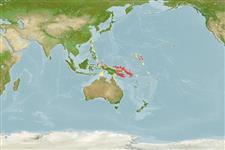
Southwest Pacific: Papua New Guinea.
Taille / Poids / Âge
Maturité: Lm ? range ? - ? cm
Max length : 73.1 cm TL mâle / non sexé; (Ref. 117108)
Description synthétique
Clés d'identification | Morphologie | Morphométrie
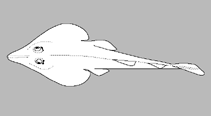
This species is distinguished by the following set of characters: a wedge-shaped disc, with its
dorsal surface covered in minute dermal denticles but without thorns; long snout, its length 3.6 times interspiracular distance; moderately large orbit, its diameter 1.7 times spiracle length; oblique nostrils, its length 1.6 times internarial distance; the anterior nasal flaps are inserted into internarial space well away from nostril margin; posterior nasal flaps are broad; ridges of rostral cartilage well-separated dorsally and almost parallel; narrow prebranchial sensory-pore patch, extending to first gill slit; distance between first gill slits is 1.5 times distance between fifth gill slits; distance between fifth gill slits is 3.4 times in ventral head length; long postscapular sensory canal, not grooved and extending more than three-quarters distance to pectoral-fin insertions; moderately tall dorsal fins; pelvic fin's inner margin is shorter than its base; interdorsal distance is more than 3.1 times first dorsal-fin base; outer spiracular fold is distinctly larger than the inner fold; dorsal margin of caudal fin ca. 2 times preventral margin; post-synarcual (free) vertebral centra 171; total vertebral centra 180; nasal lamellae 52; dorsal disc is brownish and covered with well defined rusty brown spots and blotches and poorly defined white spots with greyish edges (Ref. 117108).
Body shape (shape guide): other (see remarks); Cross section: flattened.
Cycle de vie et comportement reproducteur
Maturité | Reproduction | Frai | Œufs | Fécondité | Larves
White, W.T., P.R. Last and G.J.P. Naylor, 2016. Rhinobatos manai sp. nov., a new species of guitarfish (Rhinopristiformes: Rhinobatidae) from New Ireland, Papua New Guinea. Zootaxa 4175(6):588-600. (Ref. 117108)
Statut dans la liste rouge de l'IUCN (Ref. 130435: Version 2025-2 (Global))
Menace pour l'homme
Harmless
Utilisations par l'homme
Outils
Articles particuliers
Télécharger en XML
Sources Internet
Estimations basées sur des modèles
Indice de diversité phylogénétique (Réf.
82804): PD
50 = 0.5000 [Uniqueness, from 0.5 = low to 2.0 = high].
Bayesian length-weight: a=0.01000 (0.00244 - 0.04107), b=3.04 (2.81 - 3.27), in cm total length, based on all LWR estimates for this body shape (Ref.
93245).
Niveau trophique (Réf.
69278): 3.7 ±0.4 se; based on size and trophs of closest relatives
Résilience (Réf.
120179): Faible, temps minimum de doublement de population : 4,5 à 14 années (Preliminary low fecundity).
Vulnérabilité de la pêche (Ref.
59153): Moderate to high vulnerability (49 of 100).
🛈