Klassifizierung / Names
Namen | Synonyme | Catalog of Fishes(Gattung, Arten) | ITIS | CoL | WoRMS | Cloffa
>
Characiformes (Characins) >
Iguanodectidae ("Lizard bite tetras")
Etymology: Bryconops: Greek, bryko = to bite + Greek, ops = appearance (Ref. 45335); tocantinensis: Name refers to the rio Tocantins drainage, where this species is currently known to occur. An adjective.
Umwelt: Milieu / Klimazone / Tiefenbereich / Verbreitungsgebiet
Ökologie
; süßwasser benthopelagisch; tiefenbereich ? - 2 m (Ref. 109891). Tropical
South America: Rio Conceição, a tributary to the rio Palma, upper rio Tocantins drainage in Tocantins, Brazil.
Größe / Gewicht / Alter
Geschlechtsreife: Lm ? range ? - ? cm
Max length : 6.5 cm SL Männchen/unbestimmt; (Ref. 109891)
Kurzbeschreibung
Bestimmungsschlüssel | Morphologie | Morphometrie
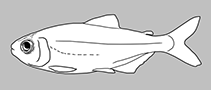
Rückenflossenweichstrahlen (insgesamt) : 10 - 11; Afterflossenweichstrahlen: 25 - 29; Wirbelzahl: 40. Bryconops tocantinensis is distinguished from all species of Bryconops, except
B. humeralis and B. vibex by the color pattern in vivo (dorsal, adipose, and caudal fins entirely orange). It differs from B. humeralis and B. vibex by the lack of a humeral spot and by the lack of maxillary teeth (vs. a single humeral spot present and 1-3 maxillary teeth on both sides present). It can be further diagnosed from B. vibex by having 38-41 perforated lateral line scales (vs. 44-46) (Ref. 109891).
Body shape (shape guide): fusiform / normal.
Inhabits stream and lotic shallow areas (depth up to 1.5 m) with riparian vegetation composed by trees and shrubs. The stream is characterized by transparent water and sandy, stony, and rocky bottom. Occurs syntopically with Eigenmannia trilineata, Hoplerythrinus unitaeniatus,
Astyanax cf. goyacensis, Knodus cf. breviceps, Knodus sp., and Ancistrus sp. (Ref. 109891).
Lebenszyklus und Paarungsverhalten
Geschlechtsreife | Fortpflanzung | Ablaichen | Eier | Fruchtbarkeit | Larven
Guedes, T.L.O., E.F. Oliveira and P.H.F. Lucinda, 2016. A new species of Bryconops (Ostariophysi: Characiformes: Characidae) from the upper rio Tocantins drainage, Brazil. Neotrop. Ichthyol. 14(2):1-8. (Ref. 109891)
IUCN Rote Liste Status (Ref. 130435: Version 2025-2 (Global))
Bedrohung für Menschen
Harmless
Nutzung durch Menschen
Tools
Zusatzinformationen
Download XML
Internet Quellen
Schätzungen auf der Grundlage von Modellen
Phylogenetischer Diversitätsindex (Ref.
82804): PD
50 = 0.5000 [Uniqueness, from 0.5 = low to 2.0 = high].
Bayesian length-weight: a=0.01072 (0.00463 - 0.02481), b=3.01 (2.81 - 3.21), in cm total length, based on LWR estimates for this (Sub)family-body shape (Ref.
93245).
Trophische Ebene (Ref.
69278): 3.2 ±0.4 se; based on size and trophs of closest relatives
Anfälligkeit der Fischerei (Ref.
59153): Low vulnerability (10 of 100).
🛈