>
Eupercaria/misc (Various families in series Eupercaria) >
Labridae (Wrasses) > Hypsigenyinae
Etymology: Choerodon: Greek, choiros = a pig + odous = teeth (Ref. 45335); referrring to the prominent anterior canines of the species in this genus (Ref. 116605); aurulentus: Name from Latin 'aurulentus' for 'ornamented with gold', referring to the prominent golden markings characterising this species.
Environnement : milieu / zone climatique / profondeur / gamme de distribution
Écologie
marin démersal; profondeur 80 - 90 m (Ref. 116605). Subtropical
Distribution
Territoires | Zones FAO | Écosystèmes | Occurrences | Carte par point | Introductions | Faunafri
South Pacific: Norfolk Ridge, ne Tasman Sea, between New Caledonia and New Zealand.
Taille / Poids / Âge
Maturité: Lm ? range ? - ? cm
Max length : 78.1 cm SL mâle / non sexé; (Ref. 116605)
Description synthétique
Clés d'identification | Morphologie | Morphométrie
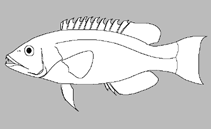
Épines dorsales (Total) : 12; Rayons mous dorsaux (Total) : 8; Épines anales: 3; Rayons mous anaux: 10; Vertèbres: 27. This species is distinguished by the following characters: D XII,8; A III,10; pectoral fin rays ii,13the , dorsalmost ray very short 7.0-9.1% pectoral fin length, ventralmost ray is distinctly longer than those immediately above, posterior edge of fin falcate, dorsoposterior corner bluntly pointed, posteroventral corner sharply pointed; shallow body, 10.6-11.4% SL, head depth 24.6-25.0% SL, caudal peduncle depth 10.6-11.4% SL; blunt head with dorsal profile of snout steeply rounded, snout length 12.0-12.2% SL; approximately 7 predorsal scales, reaching forward on dorsal midline just in advance of posterior edge of preopercle; the cheek with small partially embedded scales in about four diagonal rows, posteriormost with about 7 scales to upper extent of free preopercular edge, scales not reaching forward quite to below centre of eye, lower third or more of cheek above ventral edge of preopercle naked; 1-2 rows of about 7 or 8 small scales on subopercle adjacent preopercular edge extending forward to just more than half way to anterior extent of free ventral preopercular edge; each lateral line scale has an unbranched laterosensory canal tube; cephalic sensory canal pores are moderately numerous, confined to lines or short branches associated with major canals between and behind eye, less numerous in front of and below eye; scales above lateral line about 2½; the second pair of canines in lower jaw is directed laterally, recurved posteriorly; dorsal and anal fins without basal sheath, additional small scale at top of some oblique rows; posterior lobe of dorsal and anal fins just reaching hypural crease; caudal fin truncate, posterior margin mostly straight, upper and lower corners slightly pointed; pelvic fin to anus or anal fin origin, length 24.6-25.8% SL; colouration, green above, white below with pearly blue midlateral stripe angled from underside of eye to base of caudal fin, additional blue stripes curving from front of eye to upper jaw and across lower part of head from underside of lower jaw to preopercular margin; colour of terminal phase golden midlaterally, scales with vertical pearly bar and second pearly blue stripe from back of eye along lateral line to top of caudal peduncle; scales posteroventrally with vertical pearly blue line; lines on head with gold margins (Ref. 116605).
Body shape (shape guide): fusiform / normal; Cross section: compressed.
Cycle de vie et comportement reproducteur
Maturité | Reproduction | Frai | Œufs | Fécondité | Larves
Gomon, M.F., 2017. A review of the tuskfishes, genus Choerodon (Labridae, Perciformes), with descriptions of three new species. Memoirs of Museum Victoria 76:1-111. (Ref. 116605)
Statut dans la liste rouge de l'IUCN (Ref. 130435: Version 2025-2 (Global))
Menace pour l'homme
Harmless
Utilisations par l'homme
Outils
Articles particuliers
Télécharger en XML
Sources Internet
Estimations basées sur des modèles
Indice de diversité phylogénétique (Réf.
82804): PD
50 = 0.5000 [Uniqueness, from 0.5 = low to 2.0 = high].
Bayesian length-weight: a=0.00955 (0.00426 - 0.02142), b=3.10 (2.91 - 3.29), in cm total length, based on LWR estimates for this (Sub)family-body shape (Ref.
93245).
Niveau trophique (Réf.
69278): 3.7 ±0.5 se; based on size and trophs of closest relatives
Résilience (Réf.
120179): Très faible, temps minimum de doublement de population supérieur à 14 ans (Preliminary K or Fecundity.).
Vulnérabilité de la pêche (Ref.
59153): High vulnerability (58 of 100).
🛈