Clasificación / Nombres
Nombres comunes | Sinónimos | Catalog of Fishes(Género, Especie) | ITIS | CoL | WoRMS | Cloffa
>
Gobiiformes (Gobies) >
Gobiidae (Gobies) > Gobiinae
Etymology: guttatus: Name from Latin plural 'gutta', referring to the distinctive orange spot on many longitudinal row scales on the lower part of the body seen whenalive or in freshly dead specimens.
Entorno: milieu / zona climática / rango de profundidad / gama de distribución
Ecología
marino asociado a arrecife; rango de profundidad 1 - 2 m (Ref. 97667). Tropical
Western Indian Ocean: Red Sea, Saudi Arabia.
Tamaño / Peso / Edad
Madurez: Lm ? range ? - ? cm
Max length : 2.4 cm SL macho / no sexado; (Ref. 97667); 2.3 cm SL (female)
Descripción breve
Claves de identificación | Morfología | Morfometría
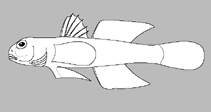
Espinas dorsales (total) : 7; Radios blandos dorsales (total) : 12; Espinas anales: 1; Radios blandos anales: 10 - 11. This species is distinguished by the following characters: D VI + I,12; A I,10-11; pectoral-fin rays 17, three upper rays with well-developed free tips, those of the first ray is longer than 3/4 of entire ray length; pelvic fins I,5, which are joined to form a disc, weakly emarginate (shortest branches of fifth ray 9/10 or more length of longest branches of fourth ray), with pelvic frenum reduced, frenum height in midline less than 1/5 length of pelvic spine; longitudinal scale series 33-35; transverse scale rows to base of the first dorsal fin and to base of the second dorsal fin 9-10; circumpeduncular scale rows 10-11; head with 7 transverse suborbital rows of sensory papillae, 5 rows in front of row b and 2 rows above row b, sixth row interrupted by row b; without tentacle above upper eye margin; anterior nostril tubular, with triangular lappet extending from posterior rim, posterior nostril slightly raised; many scales of the lower half of body are covered with dark orange spot; 2 distinct dark spots behind the edge of preopercle, and similar pair of spots at pectoral-fin base (Ref. 97667).
Body shape (shape guide): elongated; Cross section: oval.
This species was collected from shallow waters of a large inner lagoon, from the base of an isolated small coral patch (Ref. 97667).
Ciclo vital y comportamiento de apareamiento
Madurez | Reproducción | Puesta | Huevos | Fecundidad | Larva
Kovačić, M., S.V. Bogorodsky and A.O. Mal, 2014. Two new species of Coryogalops (Perciformes: Gobiidae) from the Red Sea. Zootaxa 3881(6):513-531. (Ref. 97667)
Situación en la Lista Roja de la UICN (Ref. 130435: Version 2025-2 (Global))
Amenaza para el ser humano
Harmless
Usos humanos
Herramientas
Informes especiales
Descargar XML
Fuentes de Internet
Estimaciones basadas en modelos
Índice de diversidad filogenética (Referencia
82804): PD
50 = 0.5002 [Uniqueness, from 0.5 = low to 2.0 = high].
Bayesian length-weight: a=0.00741 (0.00347 - 0.01582), b=3.09 (2.91 - 3.27), in cm total length, based on LWR estimates for this (Sub)family-body shape (Ref.
93245).
Nivel trófico (Referencia
69278): 3.1 ±0.3 se; based on size and trophs of closest relatives
Resiliencia (Referencia
120179): Alto, población duplicada en un tiempo mínimo inferior a 15 meses (Preliminary K or Fecundity.).
Vulnerabilidad pesquera (Ref.
59153): Low vulnerability (10 of 100).
🛈