Classificatie / Namen
Lokale namen | Synoniemen | Catalog of Fishes(Genus, Soort(en)) | ITIS | CoL | WoRMS | Cloffa
>
Gymnotiformes (Knifefishes) >
Sternopygidae (Glass knifefishes) > Eigenmanninae
Etymology: Eigenmannia: From Eigenmann, 1910, researcher of faunistic studies (Ref. 45335); meeki: Named for Seth Eugene Meek (1859-1914) who made many contributions to the knowledge of the diversity of the fishes of Panama.
Eponymy: Professor Dr Carl Henry Eigenmann (1863–1927) was a German-born American ichthyologist. [...] Seth Eugene Meek (1859–1914) was an ichthyologist at the Field Museum of Natural History in Chicago. [...] (Ref. 128868), visit book page.
Milieu: milieu / Klimaatzone / Diepte / verspreidingsgebied
Ecologie
; zoet water benthopelagisch. Tropical
Central America: Río Pucuro and Río Chucunaque in the Río Tuír basin, Darién Province, Panama.
Grootte / Gewicht / Leeftijd
Maturiteit: Lm ? range ? - ? cm
Max length : 30.9 cm TL mannelijk / geslacht onbekend; (Ref. 116777)
Korte beschrijving
Determinatiesleutels | Morfologie | Morfometrie
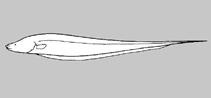
Anale zachte stralen: 211 - 240. Eigenmannia meeki is distinguished from all other species of Eigenmannia, except E. vicentespelaea, E. virescens, and E. waiwai by having the following characters: subterminal mouth (vs. terminal). It can be diagnosed from E. vicentespelaea, E. virescens, and E. waiwai by having densely covered body with dark chromatophores except at the region above the proximal portion of the pterygiophores of the anal fin, forming a pale stripe (vs. absence of such pattern); 140-168 lateral line scales to the end of the anal fin (vs. 110-125 in E. vicentespelaea, 107-127 in E. virescens, and 111-128 in E. waiwai); 211-240 rays in anal fin (vs. 169-191 in E. vicentespelaea, 180-208 in E. virescens, and 167-195 in E. waiwai); 20-23 teeth on the dentary arranged in two rows (vs. 38-45 arranged in four rows in E. vicentespelaea, 31-41 arranged in four rows in E. virescens, and 37-38 arranged in four rows in E. waiwai). It can also be differentiated from E. vicentespelaea and E. waiwai by the lack of a narrow dark stripe between the lateral line and the proximal portion of the pterygiophores (vs. present). It further differs from E. vicentespelaea by having 10-15 longitudinal series of scales above the lateral line (vs. 7 or 8), depth of the posterodorsal expansion on infraorbitals 1þ2 less than 50% the length of infraorbitals 1þ2 (vs. approximately equal to the length of infraorbitals 1þ2), and the coronomeckelian bone corresponding to 20% the length of Meckel’s cartilage (vs. 50% the length of Meckel’s cartilage). It also differs from E. virescens by having a narrow stripe on the lateral line (vs. absent); and from E. waiwai by having 15 precaudal vertebrae (vs. 12 or 13) (Ref. 116777).
Body shape (shape guide): elongated.
Levenscyclus en paargedrag
Maturiteit | Voortplanting | Paaien | Eieren | Fecunditeit | Larven
Dutra, G.M., C.D. De Santana and W.B. Wosiacki, 2017. A new species of the glass electric knifefish genus Eigenmannia Jordan and Evermann (Teleostei: Gymnotiformes: Sternopygidae) from R´ıo Tu´ıra Basin, Panama. Copeia 105(1):85-91. (Ref. 116777)
Status op de Rode Lijst van het IUCN (Ref. 130435: Version 2025-2 (Global))
Gevaar voor de mens
Harmless
Gebruik door de mens
Visserij: van geen belang
Tools
Speciale rapporten
Download XML
Internetbronnen
Schattingen op basis van modellen
Fylogenetische diversiteitsindex (Ref.
82804): PD
50 = 0.5000 [Uniqueness, from 0.5 = low to 2.0 = high].
Bayesian length-weight: a=0.00355 (0.00161 - 0.00782), b=2.97 (2.78 - 3.16), in cm total length, based on LWR estimates for this (Sub)family-body shape (Ref.
93245).
Trofisch niveau (Ref.
69278): 3.1 ±0.3 se; based on size and trophs of closest relatives
Kwetsbaarheid van de visserij (Ref.
59153): Low vulnerability (21 of 100).
🛈