Classificatie / Namen
Lokale namen | Synoniemen | Catalog of Fishes(Genus, Soort(en)) | ITIS | CoL | WoRMS | Cloffa
>
Acropomatiformes (Oceanic basses) >
Synagropidae (Splitfin ocean-basses)
Eponymy: Dr Naohide Nakayama is a Japanese ichthyologist who is (2018) Assistant Professor in the Department of Marine Biology at the School of Marine Science and Technology, Tokai University. [...] (Ref. 128868), visit book page.
Milieu: milieu / Klimaatzone / Diepte / verspreidingsgebied
Ecologie
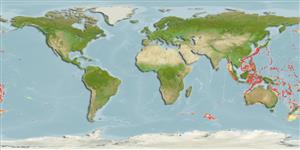
marien bathydemersaal; diepte 216 - 794 m (Ref. 116586). Subtropical
Western Pacific, known from southern Japan, Taiwan, the northern Philippines, to off Vanuatu and Wallis and Futuna; including Eastern Indian Ocean, Timor Sea and off northwestern Australia,
Grootte / Gewicht / Leeftijd
Maturiteit: Lm ? range ? - ? cm
Max length : 11.0 cm SL mannelijk / geslacht onbekend; (Ref. 116586)
Korte beschrijving
Determinatiesleutels | Morfologie | Morfometrie
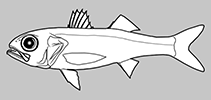
Dorsale stekels (totaal) : 10; Dorsale zachte stralen (totaal) : 8 - 9; Anale stekels: 2; Anale zachte stralen: 7. This slender species is distinguished by the following characters: flat dorsal head profile and pointed snout; A II + 7; pectoral-fin rays 15-16, pectoral length 19.5-24.3% SL; gill rakers 11-16, decreasing with size; pseudobranchial filaments 16-29, increasing in number with fish growth; first anal-fin pterygiophore is long, slightly bent, with moderately broad, hollow tip; vomer V-shaped with reduced dentition, only few long teeth near sides of base; palatine with 1 row of teeth, anteriorly long, posteriorly granular; ectopterygoid widened, 3-4 rows of granular teeth; orbital diameter 9.5-12.6% SL, decreasing with size; snout length 87-113 % of orbital diameter; no longitudinal ridges on the preopercular lobe; otolith moderately slender (OL:OH = 1.7-1.8) (Ref. 116586).
Body shape (shape guide): fusiform / normal; Cross section: compressed.
Levenscyclus en paargedrag
Maturiteit | Voortplanting | Paaien | Eieren | Fecunditeit | Larven
Schwarzhans, W.W. and A.M. Prokofiev, 2017. Reappraisal of Synagrops, Günther, 1887 with rehabilitation and revision of Parascombrops Alcock, 1889 including description of seven new species and two new genera (Perciformes: Acropomatidae). Zootaxa 4260(1):1-74. (Ref. 116586)
Status op de Rode Lijst van het IUCN (Ref. 130435: Version 2025-2 (Global))
Gevaar voor de mens
Harmless
Gebruik door de mens
Tools
Speciale rapporten
Download XML
Internetbronnen
Schattingen op basis van modellen
Fylogenetische diversiteitsindex (Ref.
82804): PD
50 = 0.5001 [Uniqueness, from 0.5 = low to 2.0 = high].
Bayesian length-weight: a=0.00977 (0.00432 - 0.02212), b=3.01 (2.82 - 3.20), in cm total length, based on LWR estimates for this (Sub)family-body shape (Ref.
93245).
Trofisch niveau (Ref.
69278): 3.5 ±0.5 se; based on size and trophs of closest relatives
Kwetsbaarheid van de visserij (Ref.
59153): Low vulnerability (10 of 100).
🛈