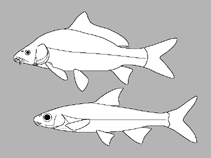
Classificazione / Nomi
Nomi Comuni | Sinonimi | Catalog of Fishes(Genere, Specie) | ITIS | CoL | WoRMS | Cloffa
>
Cypriniformes (Carps) >
Cyprinidae (Minnows or carps) > Smiliogastrinae
Etymology: Pethia: Pethia is the generic vernacular name for small cyprinids in Sinhala; sanjaymoluri: Named for Sanjay Molur from the Zoo Outreach Organization, for his contribution to the conservation of threatened taxa in the South Asian region.
Eponymy: Sanjay Molur is Director of the Zoo Outreach Organisation, India. He was honoured for his contribution to the conservation of endangered fauna in South Asia. (Ref. 128868), visit book page.
Ambiente: milieu / zona climatica / distribuzione batimetrica / gamma di distribuzione
Ecologia
; acqua dolce benthopelagico. Tropical
Asia: Bhima River, Krishna River system, Maharashtra, India.
Dimensione / Peso / Età
Maturità: Lm ? range ? - ? cm
Max length : 6.4 cm TL maschio/sesso non determinato; (Ref. 124472); peso massimo pubblicato: 3.97 g (Ref. 124472)
Breve descrizione
Chiavi di identificazione | Morfologia | Morfometria
Raggi dorsali molli (totale) : 11; Raggi anali molli: 8; Vertebre: 30. Pethia sanjaymoluri is diagnosed from all its congeners by a combination of the following characteristics: lateral line incomplete; barbels absent; fleshy upper lip; lateral-line pored scales ceasing after the seventh to 12th lateral-line scale; 23-25 scales in lateral series; 10 predorsal scales; 11-14 prepelvic scales; 17-20 pre-anal scales; 4 1?2 scales between dorsal-fin origin and lateral-line row; four scales between lateral-line row and pelvic-fin origin; last simple dorsal-fin ray strong, serrated, with 8-15 serrae on its distal half, one serra on its apical half; dorsal fin originating
behind pelvic-fin origin; caudal fin with 8+8 procurrent rays and 9+8 branched caudal-fin rays; four supraneurals; six predorsal neural spines; third infraorbital deep, overlapping preoperculum; gill rakers simple, four on lateral and 11-12 on medial margin of first ceratobranchial and four on medial side of first epibranchial; 4+5 predorsal vertebrae; 4+26 total vertebrae, with 4+13 abdominal and 13 caudal vertebrae. Body color pattern consists of a black humeral spot below the lateral line, covering third and fourth lateral-line scales and extending to one scale below the lateral-line row; a caudal spot, covering 17 th-19th scales in lateral series; apical half of dorsal-fin membrane between anterior-most five branched rays studded with melanophores, making the tip of the dorsal fin appear dark black; and anal, pelvic and pectoral fins colorless in adults (Ref. 107652).
Body shape (shape guide): fusiform / normal.
At Rawet, this species occupied the main river channel beneath riparian vegetation and submerged boulders and silt as substratum. It was found among aquatic vegetation. It co-occurred with the following fishes: Salmostoma boopis (Day 1874), Devario aequipinnatus (McClelland 1839), Rasbora daniconius (Hamilton 1822), Aplocheilus lineatus (Valenciennes 1846), Notopterus notopterus (Pallas 1769), Mastacembelus armatus (Lacépède 1800), Puntius sophore (Hamilton 1822), and Rohtee ogilbii Sykes 1839. At Bhor, it was encountered in ponds and ditches formed by boulders in the main river channel, with no riparian vegetation and with substratum composed of basalt bedrock and silt. It was observed to co-occur with the following fishes: Nemacheilus denisoni (Day 1867), R. daniconius, Garra mullya (Sykes 1839), S. boopis, Lepidocephalichthys thermalis (Valenciennes 1846) and D. aequipinnatus (Ref. 107652).
Ciclo vitale e comportamento di accoppiamento
Maturità | Riproduzione | Deposizione | Uova | Fecondità | Larve
Katwate, U., S. Jadhav, P. Kumkar, R. Raghavan and N. Dahanukar, 2016. Pethia sanjaymoluri, a new species of barb (Teleostei: Cyprinidae) from the northern Western Ghats, India. J. Fish Biol. 88(5):2027-2050. (Ref. 107652)
Stato della Lista Rossa IUCN (Ref. 130435: Version 2025-2 (Global))
Minaccia per l'uomo
Harmless
Usi umani
Strumenti
Rapporti speciali
Scarica XML
Fonti Internet
Stime basate su modelli
Indice di diversità filogenetica (Fonte Biblio.
82804): PD
50 = 0.5000 [Uniqueness, from 0.5 = low to 2.0 = high].
Bayesian length-weight: a=0.01175 (0.00633 - 0.02180), b=3.06 (2.91 - 3.21), in cm total length, based on LWR estimates for this species & Genus-body shape (Ref.
93245).
Livello trofico (Fonte Biblio.
69278): 2.6 ±0.1 se; based on size and trophs of closest relatives
Resilienza (Fonte Biblio.
120179): Alto, tempo minimo di raddoppiamento della popolazione meno di 15 mesi (Preliminary K or Fecundity.).
Vulnerabilità della pesca (Ref.
59153): Low vulnerability (10 of 100).
🛈