>
Gymnotiformes (Knifefishes) >
Hypopomidae (Bluntnose knifefishes)
Etymology: Brachyhypopomus: Greek, brachys, eia = short + Greek, hypo = under + Greek, poma, -atos = cover (Ref. 45335); provenzanoi: Named for Francisco Provenzano Rizzi, Venezuelan ichthyologist, for his contributions to Neotropical ichthyology. A noun in the genitive case.
Eponymy: Dr Francisco Provenzano Rizzi is an ichthyologist at Museum of Biology, Instituto de Zoología Tropical de la Universidad Central de Venezuela, where both his bachelor’s degree (1980) and his doctorate (2012) were awarded. [...] (Ref. 128868), visit book page.
Entorno: milieu / zona climática / rango de profundidad / gama de distribución
Ecología
; agua dulce bentopelágico; pH range: 3.1 - 4.0. Tropical; 26°C - 28°C (Ref. 116763)
South America: upper Orinoco and upper Negro (Amazonas drainage) in Venezuela.
Tamaño / Peso / Edad
Madurez: Lm ? range ? - ? cm
Max length : 9.4 cm TL macho / no sexado; (Ref. 116763); 11.0 cm TL (female)
Descripción breve
Claves de identificación | Morfología | Morfometría
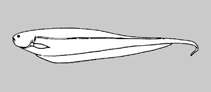
Radios blandos anales: 162 - 195. Brachyhypopomus provenzanoi is distinguished from other species of the genus Brachyhypopomus by the absence of scales in middorsal region of anterior third of body (vs. presence in all congeners except B. benjamini) and by its dorsal surface of body with irregular pattern of distinct dark blotches on depigmented tan-colored background (vs. speckled with small brown chromatophores on light brown background in B. benjamini) (Ref. 116763)
Body shape (shape guide): elongated.
Facultative air-breathing in the genus (Ref. 126274); Found in small, gently flowing, low-conductivity clearwater terra firme forest and savanna streams, and in static leaf-litter choked blackwater streams and swamps in Mauritia palm swamps. Most specimens in streams were observed sheltering in submerged and marginal aquatic vegetation growing in sandy beds, and those in Mauritia palm swamps were collected from dense leaf litter banks and root mats. Sympatric and syntopic with Brachyhypopomus bullocki, B. brevirostris, and B. sullivani in the type locality region. Food items food in the stomach contents were aquatic insect larvae and other small aquatic invertebrates (Ref. 116763).
Ciclo vital y comportamiento de apareamiento
Madurez | Reproducción | Puesta | Huevos | Fecundidad | Larva
Crampton, W.G.R., C.D. de Santana, J.C. Waddell and N.R. Lovejoy, 2017. A taxonomic revision of the Neotropical electric fish genus Brachyhypopomus (Ostariophysi: Gymnotiformes: Hypopomidae), with descriptions of 15 new species. Neotrop. ichthyol. 14(4):e150146. (Ref. 116763)
Situación en la Lista Roja de la UICN (Ref. 130435: Version 2025-2 (Global))
Amenaza para el ser humano
Harmless
Usos humanos
Pesquerías: sin interés
Herramientas
Informes especiales
Descargar XML
Fuentes de Internet
Estimaciones basadas en modelos
Índice de diversidad filogenética (Referencia
82804): PD
50 = 0.5000 [Uniqueness, from 0.5 = low to 2.0 = high].
Bayesian length-weight: a=0.00372 (0.00141 - 0.00980), b=3.06 (2.83 - 3.29), in cm total length, based on LWR estimates for this (Sub)family-body shape (Ref.
93245).
Nivel trófico (Referencia
69278): 3.1 ±0.4 se; based on size and trophs of closest relatives
Vulnerabilidad pesquera (Ref.
59153): Low vulnerability (10 of 100).
🛈