>
Acropomatiformes (Oceanic basses) >
Pempheridae (Sweepers)
Etymology: Pempheris: Greek, pempheris = the name of a fish (Ref. 45335); darvelli: Named for Brian W. Darvell, for his fieldwork in Oman resulting in the specimens and photographs of this new species.
Eponymy: Dr Brian William Darvell (d: 1948) is a chemist, academic and marine conservationist who is honorary professor at the School of Dentistry at Birmingham University, UK. [...] (Ref. 128868), visit book page.
Ambiente: milieu / zona climatica / distribuzione batimetrica / gamma di distribuzione
Ecologia
marino associati a barriera corallina; distribuzione batimetrica 6 - 7 m (Ref. 97766). Tropical
Western Indian Ocean: Oman.
Dimensione / Peso / Età
Maturità: Lm ? range ? - ? cm
Max length : 9.7 cm SL maschio/sesso non determinato; (Ref. 97766); 11.7 cm SL (female)
Breve descrizione
Chiavi di identificazione | Morfologia | Morfometria
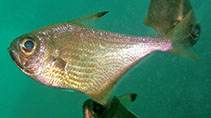
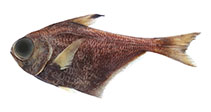
Spine dorsali (totale) : 6; Raggi dorsali molli (totale) : 9; Spine anali: 3; Raggi anali molli: 41 - 43; Vertebre: 25. This species is distinguished by the following characters: D VI,9; A III,41-43; pectoral rays 18-19; lateral-line scales 56-58; scales on anteroventral ctenoid and covering 90% of chest; gill rakers 30-32; body depth 2.1 in SL; head length 3.0-3.05 in SL; orbit diameter 7.45-7.7 in SL; caudal-fin length 3.45-3.55 in SL, moderately emarginate, caudal concavity 3.55-3.7 in head length; pectoral-fin length 3.15-3.2 in SL; colour in alcohol dark maroon brown, with the outer edge of scales broadly translucent gray; dorsal fin is pale yellowish, the distal half of first six soft rays and adjacent membranes black (dark pigment covering outer half of longest rays and adjacent membranes); anal fin and adjacent base of body darker brown than body, becoming progressively more translucent yellow distally, with a small brown spot on each scale; anal ray tips are translucent white; anterior five rays and membranes dark brown, the dark pigment also distally on the next five rays; caudal fin is dusky yellowish, darker brown basally and broadly darker all around margin; pectoral fins are yellowish gray with a large dark maroon brown spot covering entire base of fin; axil also dark maroon brown; pelvic fins are pale dusky yellowish (Ref. 97766).
Body shape (shape guide): short and / or deep; Cross section: compressed.
Ciclo vitale e comportamento di accoppiamento
Maturità | Riproduzione | Deposizione | Uova | Fecondità | Larve
Randall, J.E. and B.C. Victor, 2014. Four new fishes of the genus Pempheris (Perciformes: Pempheridae) from the western Indian Ocean. J. Ocean Sci. Found. 12:61-83. (Ref. 97766)
Stato della Lista Rossa IUCN (Ref. 130435: Version 2025-2 (Global))
Minaccia per l'uomo
Harmless
Usi umani
Strumenti
Rapporti speciali
Scarica XML
Fonti Internet
Stime basate su modelli
Indice di diversità filogenetica (Fonte Biblio.
82804): PD
50 = 0.5000 [Uniqueness, from 0.5 = low to 2.0 = high].
Bayesian length-weight: a=0.01380 (0.00586 - 0.03254), b=3.01 (2.82 - 3.20), in cm total length, based on LWR estimates for this Genus-body shape (Ref.
93245).
Livello trofico (Fonte Biblio.
69278): 3.4 ±0.5 se; based on size and trophs of closest relatives
Resilienza (Fonte Biblio.
120179): Alto, tempo minimo di raddoppiamento della popolazione meno di 15 mesi (Preliminary K or Fecundity.).
Vulnerabilità della pesca (Ref.
59153): Low vulnerability (10 of 100).
🛈