>
Gymnotiformes (Knifefishes) >
Hypopomidae (Bluntnose knifefishes)
Etymology: Brachyhypopomus: Greek, brachys, eia = short + Greek, hypo = under + Greek, poma, -atos = cover (Ref. 45335); batesi: Named for Henry Walter Bates (1825-1892), British naturalist and explorer, for his contributions to the natural history of the Tefé region, where the type series was collected.
Eponymy: Henry Walter Bates (1825–1892) was an English explorer and naturalist. [...] (Ref. 128868), visit book page.
Entorno: milieu / zona climática / rango de profundidad / gama de distribución
Ecología
; agua dulce bentopelágico; pH range: 4.5 - 6.0. Tropical; 24°C - 27°C (Ref. 116763)
South America: Central Amazon and upper rio Negro in Brazil and Colombia.
Tamaño / Peso / Edad
Madurez: Lm ? range ? - ? cm
Max length : 12.0 cm TL macho / no sexado; (Ref. 116763); 12.1 cm TL (female)
Descripción breve
Claves de identificación | Morfología | Morfometría
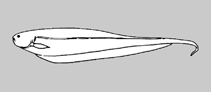
Radios blandos anales: 159 - 173. Brachyhypopomus batesi can be distinguished from other species of the genus Brachyhypopomus by the following combination of characters: anal fin with 165-179 rays (vs. 180-293 in B. alberti, B. beebei, B. belindae, B. bennetti, B. brevirostris, B. bullocki, B. diazi, B. gauderio, B. hendersoni, B. janeiroensis, B. jureiae, B. occidentalis, B. palenque, B. verdii, and B. walteri); presence of scales in entire middorsal region, although sparse and hard to see in some specimens (vs. absence in middorsal region of anterior third of body in B. benjamini and B. provenzanoi); absence of accessory electric organ over the opercular region (vs. presence in B. bombilla, B. menezesi, and B. regani; head depth at occiput 61.0-67.9% HL, (vs. 71.4-94.6% in B. cunia, B. draco, B. flavipomus, B. hamiltoni, and B. pinnicaudatus); and absence of scattered conspicuous black or charcoal flecks on flanks (vs. presence in B. sullivani) (Ref. 116763).
Body shape (shape guide): elongated.
Facultative air-breathing in the genus (Ref. 126274); The type series was sampled from the lower, seasonally flooded reaches of low-conductivity blackwater rainforest streams that flow into lago Tefé, and lago Amanã (large blackwater ria lakes of similar conductivity to the streams). Mostly found in marginal root mats or submerged leaf litter along stream edges. The recorded water parameters at the time of sampling were the following: conductivity 10-30 μScm-1, dissolved oxygen 2.0-5.2 mgl-1, temperature 24.3-27.0°C, and pH 4.5-6.0. During the high water period, this species disappears from the flood-swollen lower stream reaches which is possibly due to declining dissolved oxygen levels, and apparently moves upstream to terra firme stream reaches above the seasonal river-floodplain flood influence. Breeds during the early rising-water period, which in the Tefé region corresponds to the rainy season. Occurrence of this species outside the sampling area of type series localities are all recorded from low-conductivity blackwater rainforest streams. In the region of the type locality, Brachyhypopomus batesi co-exists in geographical sympatry and ecological syntopy with the following species occurring in terra firme stream: B. beebei, B. brevirostris, B. sullivani, and B. walteri. It is also allotropic in distribution with B. belindae, B. bennetti, B. flavipomus, B. hamiltoni, B. hendersoni, B. pinnicaudatus, and B. regani. In the rio Negro, it occurs in geographical sympatry with B. beebei, B. brevirostris, B. bullocki, B. hendersoni, B. regani, B. sullivani, and B. Walteri. Feeds on aquatic insect larvae (primarily Chironomidae), and other small aquatic invertebrates (Ref. 116763).
Ciclo vital y comportamiento de apareamiento
Madurez | Reproducción | Puesta | Huevos | Fecundidad | Larva
Crampton, W.G.R., C.D. de Santana, J.C. Waddell and N.R. Lovejoy, 2017. A taxonomic revision of the Neotropical electric fish genus Brachyhypopomus (Ostariophysi: Gymnotiformes: Hypopomidae), with descriptions of 15 new species. Neotrop. ichthyol. 14(4):e150146. (Ref. 116763)
Situación en la Lista Roja de la UICN (Ref. 130435: Version 2025-2 (Global))
Amenaza para el ser humano
Harmless
Usos humanos
Pesquerías: sin interés
Herramientas
Informes especiales
Descargar XML
Fuentes de Internet
Estimaciones basadas en modelos
Índice de diversidad filogenética (Referencia
82804): PD
50 = 0.5000 [Uniqueness, from 0.5 = low to 2.0 = high].
Bayesian length-weight: a=0.00372 (0.00141 - 0.00980), b=3.06 (2.83 - 3.29), in cm total length, based on LWR estimates for this (Sub)family-body shape (Ref.
93245).
Nivel trófico (Referencia
69278): 3.1 ±0.4 se; based on size and trophs of closest relatives
Vulnerabilidad pesquera (Ref.
59153): Low vulnerability (10 of 100).
🛈