Classificazione / Nomi
Nomi Comuni | Sinonimi | Catalog of Fishes(Genere, Specie) | ITIS | CoL | WoRMS | Cloffa
>
Osteoglossiformes (Bony tongues) >
Mormyridae (Elephantfishes)
Etymology: Paramormyrops: Greek, para = near + Greek, mormyros = a fish (Sparus sp) (Ref. 45335); ntotom: The species name, ntotom, is the word for mormyrid fish in the language of the Fang people from northern Gabon, Equatorial Guinea and southern Cameroon (Ref. 116799).
Ambiente: milieu / zona climatica / distribuzione batimetrica / gamma di distribuzione
Ecologia
; acqua dolce benthopelagico. Tropical
Africa: Ogowe River in Gabon (Ref. 116799).
Dimensione / Peso / Età
Maturità: Lm ? range ? - ? cm
Max length : 18.3 cm SL maschio/sesso non determinato; (Ref. 116799)
Breve descrizione
Chiavi di identificazione | Morfologia | Morfometria
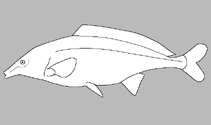
Spine dorsali (totale) : 0; Raggi dorsali molli (totale) : 19 - 21; Spine anali: 0; Raggi anali molli: 24 - 26; Vertebre: 41 - 44. Diagnosis: Paramormyrops ntotom is distinguished from all other Lower-Guinea Paramormyrops by a combination of morphological and electrical characteristics: 5 teeth in upper-jaw, 6 in lower; 12 circumpeduncular scales; V-shaped snout profile viewed from above, snout angle 38-50°, corresponding to an interorbital width 0.8-1.05 times the snout length; body depth 14.9-18.1% of standard length, 81-91.6% of body depth at urogenital pore; eye diameter 12.4-14.7% of head length measured to end of opercular bone; snout length 23.8-28.3% of head length; ratio of head length to depth 1.25-1.40; head length 20.4-24.6% of standard length; EOD waveform with two phases, head positive then negative, duration 4.78 ± 1.10 ms with a corresponding peak power spectral frequency, 265 ± 67 Hz; electric organ composed of type NPp electrocytes (Ref. 116799). With its 5/6 teeth, 12 circumpeduncular scales and sharp snout, Paramormyrops ntotom differs from all other described Paramormyrops except P. curvifrons and P. spekodes (Ref. 116799). Five morphological characters distinguish P. ntotom from P. curvifrons: ratio of head length to standard length shorter in P. ntotom compared with P. curvifrons; slight concave depression in the forehead in advance of the orbit and a relatively compact snout compared to P. curvifrons which has a longer snout, downward sloping, often with a slightly protruding chin and upper lip; shorter prepectoral distance relative to predorsal distance; snout angle greater in P. ntotom than P. curvifrons; and the head depth relative to head length greater in P. ntotom than in P. curvifrons; EOD duration slightly longer in P. ntotom compared with P. curvifrons, with extensive overlap; both species have type NPp electrocytes in the electric organ and both exhibit sex differences in EOD duration (Ref. 116799). Paramormyrops ntotom differs from P. sphekodes in the six following morphological characters: larger overall size at sexual maturity; head more elongate and less rounded; snout reduced; larger caudal peduncle depth to length ratio; the smaller eye diameter relative to head length; and the greater EOD duration; when alive P. ntotom is most easily distinguished from P. sphekodes by its longer EOD duration and a correspondingly lower peak spectral frequency; the EODs of P. ntotom and P. sphekodes also differ in shape, with the width of first and second phase being equal for P. ntotom, while W1 is longer than W2 in P. sphekodes; living specimens of these two species also differ in colouration: dorsal and anal fin pigmentation tends to be darker in P. ntotom than P. sphekodes, and the ground colour of the skin tends to be darker chocolate brown compared to yellow brown in P. sphekodes (Ref. 116799).
Body shape (shape guide): elongated.
Ciclo vitale e comportamento di accoppiamento
Maturità | Riproduzione | Deposizione | Uova | Fecondità | Larve
Rich, M., J.P. Sullivan and C.D. Hopkins, 2017. Rediscovery and description of Paramormyrops sphekodes (Sauvage, 1879) and a new cryptic Paramormyrops (Mormyridae: Osteoglossiformes) from the Ogooué River of Gabon using morphometrics, DNA sequencing and electrophysiology. Zool. J. Linn. Soc. 180:613-646. (Ref. 116799)
Stato della Lista Rossa IUCN (Ref. 130435: Version 2025-2 (Global))
Minaccia per l'uomo
Harmless
Usi umani
Strumenti
Rapporti speciali
Scarica XML
Fonti Internet
Stime basate su modelli
Indice di diversità filogenetica (Fonte Biblio.
82804): PD
50 = 0.5010 [Uniqueness, from 0.5 = low to 2.0 = high].
Bayesian length-weight: a=0.00562 (0.00248 - 0.01273), b=3.05 (2.85 - 3.25), in cm total length, based on LWR estimates for this (Sub)family-body shape (Ref.
93245).
Livello trofico (Fonte Biblio.
69278): 3.2 ±0.3 se; based on size and trophs of closest relatives
Resilienza (Fonte Biblio.
120179): Alto, tempo minimo di raddoppiamento della popolazione meno di 15 mesi (Preliminary K or Fecundity.).
Vulnerabilità della pesca (Ref.
59153): Low vulnerability (12 of 100).
🛈