>
Gymnotiformes (Knifefishes) >
Hypopomidae (Bluntnose knifefishes)
Etymology: Brachyhypopomus: Greek, brachys, eia = short + Greek, hypo = under + Greek, poma, -atos = cover (Ref. 45335); arrayae: Named for the Bolivian biologist Mariana Arraya for her assistance in collecting the type series in Bolivia.
Eponymy: Mariana Arraya is a Bolivian biologist at Unidad de Limnologia y Recursos Acuaticos, Universidad Mayor de San Simon. She was thanked in the etymology “…for her assistance in collecting the type series in Bolivia.” (Ref. 128868), visit book page.
Entorno: milieu / zona climática / rango de profundidad / gama de distribución
Ecología
; agua dulce bentopelágico; pH range: 7.5 - 7.6. Tropical; 27°C - 28°C (Ref. 116763)
South America: upper Madeira River basin in Bolivia, Brazil, and Peru.
Tamaño / Peso / Edad
Madurez: Lm ? range ? - ? cm
Max length : 16.0 cm TL macho / no sexado; (Ref. 116763); 13.3 cm TL (female)
Descripción breve
Claves de identificación | Morfología | Morfometría
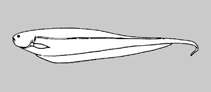
Radios blandos anales: 175 - 212. Brachyhypopomus arrayae can be distinguished from other species of the genus Brachyhypopomus by the following combination of characters: presence of prominent pale uninterrupted middorsal stripe from occipital region to base of caudal filament (vs. absence in all congeners except B. beebei, B. belindae, B. flavipomus, B. gauderio, B. pinnicaudatus, and B. verdii); anal-fin with 174-212 rays (vs. 214-230 in B. beebei; precaudal vertebrae 20-23 (vs. 24-26 in B. belindae and B. verdii); pectoral fin with 16-19 rays, mode 16 (vs. 12-15, mode 13 for B. gauderio (except populations from Uruguay drainages) and vs. 13-15, mode 14 for B. pinnicaudatus (except populations from coastal French Guiana). It has similar pigmentation and overlapping meristic counts and morphometric proportions with some populations of B. gauderio and B. pinnicaudatus from which it can be distinguished by the contact of a small ascending process on the endopterygoid (mesopterygoid of Mago-Leccia, 1978) with the orbitosphenoid (Arratia & Schultze, 1991; de Santana & Crampton, 2011), (vs. the lack of a contact between the ascending process on the endopterygoid and the orbitosphenoid in B. gauderio and B. pinnicaudatus (Ref. 116763).
Body shape (shape guide): elongated.
Facultative air-breathing in the genus (Ref. 126274); The type series was sampled from high-conductivity whitewater floodplain sites and from the lower, seasonally inundated reaches of terra firme streams. Found most commonly in marginal root
mats, and in emergent or submerged aquatic vegetation. The recorded water parameters at the sampling sites were the following: conductivity 150-160 μScm-1, dissolved oxygen 5.0-6.0 mgl-1, temperature 27-28°C, and pH 7.5-7.6. Adults in spawning condition were observed during the dry season in June-July 2007. Aquatic insect larvae and other small aquatic invertebrates were found in the stomach contents of specimens from the type locality. Brachyhypopomus arrayae co-occurs in geographical sympatry and ecological syntopy with whitewater floodplain-occurring species such as B. bombilla, B. brevirostris, B. pinnicaudatus, and B. walteri. Largely allotopic in the region of the type locality with the following terra firme stream occurring species: B. alberti and B. sullivani, although B. arrayae was found with B. alberti at the ecotone between terra firme streams and floodplain systems (Ref. 116763).
Ciclo vital y comportamiento de apareamiento
Madurez | Reproducción | Puesta | Huevos | Fecundidad | Larva
Crampton, W.G.R., C.D. de Santana, J.C. Waddell and N.R. Lovejoy, 2017. A taxonomic revision of the Neotropical electric fish genus Brachyhypopomus (Ostariophysi: Gymnotiformes: Hypopomidae), with descriptions of 15 new species. Neotrop. ichthyol. 14(4):e150146. (Ref. 116763)
Situación en la Lista Roja de la UICN (Ref. 130435: Version 2025-2 (Global))
Amenaza para el ser humano
Harmless
Usos humanos
Pesquerías: sin interés
Herramientas
Informes especiales
Descargar XML
Fuentes de Internet
Estimaciones basadas en modelos
Índice de diversidad filogenética (Referencia
82804): PD
50 = 0.5000 [Uniqueness, from 0.5 = low to 2.0 = high].
Bayesian length-weight: a=0.00372 (0.00141 - 0.00980), b=3.06 (2.83 - 3.29), in cm total length, based on LWR estimates for this (Sub)family-body shape (Ref.
93245).
Nivel trófico (Referencia
69278): 3.1 ±0.4 se; based on size and trophs of closest relatives
Vulnerabilidad pesquera (Ref.
59153): Low vulnerability (10 of 100).
🛈