Klassificering / Namn
Populärnamn | synonymer | Catalog of Fishes(Släkte, Arter) | ITIS | CoL | WoRMS | Cloffa
>
Cyprinodontiformes (Rivulines, killifishes and live bearers) >
Nothobranchiidae (African rivulines)
Etymology: Aphyosemion: Greek, aphye, -es, sardine, anchovy + Greek, semeion = mark, signal (Ref. 45335); bitteri: The new species is dedicated to Friedrich Bitter, German killifish hobbyist and member of the DKG (German Killifish Association), for his contribution to the knowledge on African killifishes (Ref. 116793).
Eponymy: Friedrich Bitter is a German biologist, aquarist and editor-in-chief of Aquaristik. [...] (Ref. 128868), visit book page.
Miljö: miljö / Klimatzon / djupintervall / distributionsområde
Ekologi
; sötvatten bentopelagisk. Tropical
Africa: Ikoy River basin in Gabon (Ref. 116793).
Storlek / Vikt / Ålder
Könsmognad: Lm ? range ? - ? cm
Max length : 2.9 cm SL hane/ej könsbestämd; (Ref. 116793)
Kort beskrivning
Bestämningsnycklar | Morfologi | Morfometri
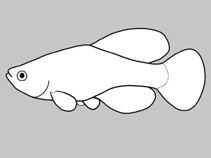
Taggstrålar i ryggfenan (totalt) : 0; Mjukstrålar i ryggfenan (totalt) : 9 - 10; Taggstrålar i analfenan: 0; Mjukstrålar i analfenan: 11 - 12. Diagnosis: Males of Aphyosemion bitteri can be distinguished from all other congeners by presenting a maze-like red pattern on the caudal fin; they also differ from all the other species of the genus, except members of the A. grelli species group, by having the basal two thirds of the unpaired fins of females yellow, and the marginal third greyish (Ref. 116793). Males of A. bitteri can be easily distinguished from males of A. grelli by a denser red pigmentation on the flanks consisting of four parallel horizontal lines becoming wider posteriorly, vs. two or three parallel horizontal lines of isolated red dots; by the dense red pigmentation of the unpaired fins, consisting of four horizontal bands on the dorsal fin, undulating coalescent red lines parallel to the fin rays on the caudal fin, and three horizontal red lines on the anal fin, sometimes coalescent and in some specimens forming a pattern similar to that of the caudal fin, vs. no red pigmentation on the unpaired fins or a few isolated red dots on the central part of the caudal; by having more scales in the circumpeduncular series in both sexes, 13-14 vs. 12; less anal fin rays, 11-12 vs. 13-14; and interrupted neuromast series in the median longitudinal series, vs. neuromast series in the median longitudinal series complete (Ref. 116793). Males of A. bitteri can be easily distinguished from A. mengilai by the dense red pigmentation of the unpaired fins, vs. sparse red pigmentation; by the continuous parallel horizontal red lines on the caudal peduncle wider than the interspaces, vs. interrupted red lines consisting of short series of small dots, in some cases forming a reticulated pattern; by having less dorsal and anal fin rays in both sexes, 9-10 vs. 13-14 and 11-12 vs. 15-16, respectively; by less scales around the caudal peduncle, 13-14 vs. 15-18; by less scales in the transverse series, 9-10 vs. 11-12; by interrupted neuromast series in the median longitudinal series, vs. neuromast series in the median longitudinal series complete; and by a distinct maximum standard length, with A. bitteri attaining less than 30 mm standard length versus more than 40 mm standard length for A. mengilai (Ref. 116793). Males of A. bitteri can be easily distinguished from males of A. escherichi, known from the same geographical area, by a dense red pigmentation on the flanks, consisting of four parallel horizontal lines becoming wider posteriorly which are as wide as the interspaces and fade into the red pigmentation of the caudal fin, vs. three to four very regular parallel horizontal lines of coalescent red dots with the interspaces wider than the lines ending at the posterior edge of the caudal peduncle; by the narrow dark grey dorsal and ventral margins of the unpaired fins, vs. yellowish and wider with red submarginal bands; and by the red pigmentation of the unpaired fins, forming a maze-like pattern, vs. numerous isolated red dots on the median part of the caudal and the basal two thirds of the anal fin (Ref. 116793).
Body shape (shape guide): fusiform / normal.
Found in a stream not wider than 60 cm and not deeper than 20 cm; no aquatic vegetation was present; only freshwater shrimps, tadpoles, and aquatic insects were present (Ref. 116793).
Livscykel och parningsbeteende
Könsmognad | Reproduktion | Lek | Ägg | Fekunditet | Larver
Valdesalici, S. and W. Eberl, 2016. Aphyosemion bitteri (Cyprinodontiformes: Nothobranchiidae), a new killifish species from the northern Massif du Chaillu, Gabon. aqua, Int. J. Ichthyol. 22(2):61-68. (Ref. 116793)
Status på IUCN:s rödlista (Ref. 130435: Version 2025-2 (Global))
Hot mot människor
Harmless
Mänskliga användningsområden
Verktyg
Särskilda rapporter
Ladda ner XML
Internet-källor
Uppskattningar baserade på modeller
Index för fylogenetisk mångfald (Ref.
82804): PD
50 = 0.5000 [Uniqueness, from 0.5 = low to 2.0 = high].
Bayesian length-weight: a=0.00603 (0.00250 - 0.01453), b=3.13 (2.93 - 3.33), in cm total length, based on LWR estimates for this (Sub)family-body shape (Ref.
93245).
Trofisk nivå (Ref.
69278): 3.1 ±0.4 se; based on size and trophs of closest relatives
Sårbarhet i fisket (Ref.
59153): Low vulnerability (10 of 100).
🛈