Classification / Noms
Noms communs | Synonymes | Catalog of Fishes(Genre, Espèce) | ITIS | CoL | WoRMS | Cloffa
>
Siluriformes (Catfishes) >
Diplomystidae (Velvet catfishes)
Etymology: Diplomystes: Greek, diploos = twice + Greek, mystax, -akos = lip (Ref. 45335); incognitus: The specific epithet incognitus is in reference that recognition of the species was obscured by the assumption that Diplomystes chilensis also extended south of Maipo Basin.
Environnement : milieu / zone climatique / profondeur / gamme de distribution
Écologie
; eau douce démersal. Tropical
South America: Rapel, Mataquito, Maule, and Itata Basins in Chile.
Taille / Poids / Âge
Maturité: Lm ? range ? - ? cm
Max length : 15.3 cm SL mâle / non sexé; (Ref. 116749)
Description synthétique
Clés d'identification | Morphologie | Morphométrie
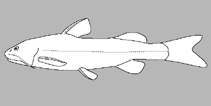
Épines dorsales (Total) : 2; Rayons mous dorsaux (Total) : 6 - 7; Rayons mous anaux: 13; Vertèbres: 40. Diplomystes incognitus can be diagnosed from other species of the genus Diplomystes by having the following characters: skin of head, body, and fins densely covered by round, short papillae giving the skin a blackberry-like or verrucose aspect in large individuals; with a short head, slightly squarish and as long as broad (vs. slightly longer more triangular-shaped head); height of dorsal fin, ca. 20% of SL (range 17-25%) and triangularly-shaped (vs. slightly rhomboidal); maxilla with 7-9 teeth (vs. 8-13 in D. chilensis, 11-3 in D. nahuelbutaensis, and 12-19 in D. camposensis); with 10 infraorbital bones, as in D. nahuelbutaensis, but the dorsalmost compound bone is absent; urogenital pore and anus placed between posterior tips of pelvic fins as in D. chilensis (vs. urogenital pore and anus placed between pelvic fins or in between the distal tips of pelvics and anal fin); lack of pores of axillary gland with occasionally four on one side of body (vs. two or three pores) (Ref. 116749).
Cycle de vie et comportement reproducteur
Maturité | Reproduction | Frai | Œufs | Fécondité | Larves
Arratia, G. and C. Quezada-Romegialli, 2017. Understanding morphological variability in a taxonomic context in Chilea diplomystids (Teleostei: Siluriformes), including the description of a new species. PeerJ 5:e2991. (Ref. 116749)
Statut dans la liste rouge de l'IUCN (Ref. 130435: Version 2025-2 (Global))
Menace pour l'homme
Harmless
Utilisations par l'homme
Outils
Articles particuliers
Télécharger en XML
Sources Internet
Estimations basées sur des modèles
Indice de diversité phylogénétique (Réf.
82804): PD
50 = 0.5703 [Uniqueness, from 0.5 = low to 2.0 = high].
Bayesian length-weight: a=0.00457 (0.00174 - 0.01201), b=3.12 (2.90 - 3.34), in cm total length, based on LWR estimates for this (Sub)family-body shape (Ref.
93245).
Niveau trophique (Réf.
69278): 3.3 ±0.5 se; based on size and trophs of closest relatives
Vulnérabilité de la pêche (Ref.
59153): Low vulnerability (10 of 100).
🛈