>
Gobiesociformes (Clingfishes) >
Gobiesocidae (Clingfishes and singleslits) > Cheilobranchinae
Etymology: Nettorhamphos: Name from Greek 'netta' (duck) and 'rhamphos' (bill), referring to the curved bill; radula: Name from Latin 'radula', a tool used for scraping; referring to the many tiny conical teeth on the lingual surface of the premaxilla and dentary, reminiscent of the radula of a snail; noun in apposition.
Окружающая среда: среда / климатическая зона / пределы глубины / диапазон распространения
экология
морской ассоциированный с рифами; пределы глубины 33 - 37 m (Ref. 116784). Tropical
Eastern Indian Ocean: Western Australia.
Размер / Вес / Возраст
половая зрелость: Lm ? range ? - ? cm
Max length : 4.0 cm SL самец/пол неопределен; (Ref. 116784)
Краткое описание
определительные ключи | морфология | морфометрия
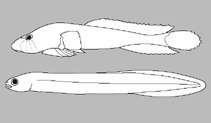
This species is distinguished by the following characters: unique features of oral jaws, including: an upper jaw which is much wider and longer than the lower jaw, creating a large gap between the outermost teeth of the upper jaw and those of the lower jaw (vs. upper and lower jaws similar in width and length and without obvious gap between outermost teeth of the upper jaw and those of the lower jaw or upper jaw only slightly wider and longer than the lower jaw creating a narrow gap between the outermost teeth of the upper jaw and those of the lower jaw); with tiny dagger-like conical teeth of uniform size arranged in multiple rows in both the upper (premaxilla; ca. 15 rows) and lower jaw (dentary; ca. 10 rows; vs. single row of conical teeth along the upper and lower jaws, a few short, staggered rows of incisiviform and/or conical teeth along both the upper and lower jaw, or conical teeth arranged in a broad patch anteriorly tapering to a single row posteriorly along both the upper and lower jaws); medial face of dentary without an anteromedially directed spine-like process; borad snout, rounded anteriorly, upper lip separated from snout by a shallow groove; adhesive disc double, with papillae present along the entire anterior margin of disc region A; patches of papillae on disc regions C and D; gill openings are large, joined across isthmus; presence of a well-developed spine laterally on head, formed by a heavily ossified subopercle; dorsal and anal fins are widely separated from caudal fin; dorsal fin with fewer fin rays compared to anal fin (Ref. 116784).
Body shape (shape guide): elongated; Cross section: oval.
Жизненный цикл и брачное поведение
половая зрелость | размножение | нерест | икра | Плодовитость | личинки
Conway, K.W., G.I. Moore and A.P. Summers, 2017. A new genus and species of clingfish (Teleostei: Gobiesocidae) from Western Australia. Copeia 105(1):128-140. (Ref. 116784)
Статус Красного Списка МСОП (Ref. 130435: Version 2025-2 (Global))
Угроза для людей
Harmless
Использование человеком
рыболовство: bycatch
дополнительная информация
инструменты
Специальные отчеты
Скачать в формате XML
ресурсы в Интернет
Оценки, основанные на моделях
Индекс филогенетического разнообразия (ссылка
82804): PD
50 = 1.0000 [Uniqueness, from 0.5 = low to 2.0 = high].
Bayesian length-weight: a=0.00389 (0.00180 - 0.00842), b=3.12 (2.94 - 3.30), in cm total length, based on all LWR estimates for this body shape (Ref.
93245).
Трофический уровень (ссылка
69278): 3.2 ±0.3 se; based on size and trophs of closest relatives
устойчивость к внешним воздействиям (ссылка
120179): высокий, минимальное время удвоения популяции до 15 месяцев (Preliminary K or Fecundity.).
Уязвимость рыбной ловли (Ref.
59153): Low vulnerability (10 of 100).
🛈