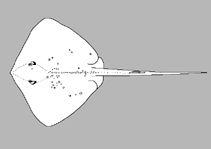
Klassifizierung / Names
Namen | Synonyme | Catalog of Fishes(Gattung, Arten) | ITIS | CoL | WoRMS | Cloffa
Elasmobranchii (Haie und Rochen) (sharks and rays) >
Myliobatiformes (Stingrays) >
Dasyatidae (Stingrays) > Neotrygoninae
Etymology: caeruleopunctata: Name from Latin 'caeruleus' (sky blue) and 'punctum' (dot or spot), referring to its bluespotted coloration and having a wider distribution than other blue-spotted forms.
Umwelt: Milieu / Klimazone / Tiefenbereich / Verbreitungsgebiet
Ökologie
seewasser riff-verbunden. Tropical
Indian Ocean: southern Indonesia and possibly westward to Africa.
Größe / Gewicht / Alter
Geschlechtsreife: Lm ? range ? - ? cm
Max length : 45.0 cm WD Männchen/unbestimmt; (Ref. 116741); 47.1 cm WD (female)
Kurzbeschreibung
Bestimmungsschlüssel | Morphologie | Morphometrie
This large species of the kuhlii-complex (reaching at least 47 cm DW; males maturing at 31 cm DW) is distinguished by the following set of characters: disc is much broader than long, width 1.2-1.3 times length; pectoral apices are abruptly angular; snout fleshy, broadly rounded to obtuse, with angle 125-130°, its length 1.8-2.4 times interorbital width; maximum width is relatively well forward on disc, length from snout tip to pectoral-fin insertion 1.9-2 times and disc width 2.6-2.9 times horizontal distance from snout tip to maximum disc width; preoral length 1.6-2.3 times mouth width; internasal distance 1.4-1.8 in prenasal length; interspiracular distance 13-14% DW; nostril length 2.5-3.5% DW; nasal curtain width 8-9.4% DW; small mouth, its width 6.6-7.9% DW; horizontal distance from cloaca to caudal sting base 51-56% of disc length; thornlets are present in nuchal and lumbar regions in large individuals, but none from tail in all sizes; dermal denticles are entirely absent from body; pectoral-fin radials 105-110; total vertebral centra (including synarcual) 133-142, trunk centra (including synarcual) 38-43; blue spots are medium-sized, largest spot on disc 0.5-0.8 times eye width; with 0-3 (mean 0.8) blue spots on medial belt, largest 1.7-2.7% DW; mask-like marking dark, not covered with dark peppery spots; ventral surface of disc and pelvic fins are with sharply defined dark greyish brown submarginal bands; dark ventral tail before caudal sting; ventral tail fold is almost entirely dark in young (Ref. 116741).
Body shape (shape guide): other; Cross section: flattened.
This demersal fish occurs inshore to mid-continental and insular shelves. Males mature at 31 cm DW and individuals born ca 17 cm DW (Ref. 114953).
Lebenszyklus und Paarungsverhalten
Geschlechtsreife | Fortpflanzung | Ablaichen | Eier | Fruchtbarkeit | Larven
Last, P.R., White, W.T. and B. Séret, 2016. Taxonomic status of maskrays of the Neotrygon kuhlii species complex (Myliobatoidei: Dasyatidae) with the description of three new species from the Indo-West Pacific. Zootaxa 4083(4):533-561. (Ref. 116741)
IUCN Rote Liste Status (Ref. 130435: Version 2025-2 (Global))
Bedrohung für Menschen
Harmless
Nutzung durch Menschen
Fischereien: nicht kommerziell
Tools
Zusatzinformationen
Download XML
Internet Quellen
Schätzungen auf der Grundlage von Modellen
Phylogenetischer Diversitätsindex (Ref.
82804): PD
50 = 0.5000 [Uniqueness, from 0.5 = low to 2.0 = high].
Bayesian length-weight: a=0.01096 (0.00352 - 0.03419), b=3.12 (2.87 - 3.37), in cm total length, based on LWR estimates for this (Sub)family-body shape (Ref.
93245).
Trophische Ebene (Ref.
69278): 3.4 ±0.3 se; based on size and trophs of closest relatives
Anfälligkeit der Fischerei (Ref.
59153): Moderate vulnerability (40 of 100).
🛈