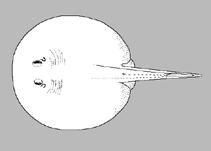
Potamotrygon adamastor

You can sponsor this page

Potamotrygon adamastor Fontenelle & Carvalho, 2017

Hochladen Photos und videos
Google Bild
Image of Potamotrygon adamastor
No image available for this species;
drawing shows typical species in Potamotrygonidae.

Klassifizierung / Names Namen | Synonyme | Catalog of Fishes(Gattung, Arten) | ITIS | CoL | WoRMS | Cloffa

Elasmobranchii (Haie und Rochen) (sharks and rays) > Myliobatiformes (Stingrays) > Potamotrygonidae (River stingrays) > Potamotrygoninae
Etymology: Potamotrygon: Greek, potamos = river + Greek, trygon = a sting ray (Ref. 45335)adamastor: Named for Adamastor, one of the giants of Greek mythology who opposed Zeus and Thetis and was thereby sent to Earth, acting as a raging storm over the Cape of Storms. The epithet adamastor is an adaptation of the Greek 'Adamastos', which means untamed. A noun in apposition.
Eponymy: Adamastor is a mythic character created by the Portuguese poet, Luís Vaz de Camões, who gave his creation a ‘backstory’ as one of the Giants in Greek mythology, although the name does not actually appear in Greek myth. (Ref. 128868), visit book page.

Umwelt: Milieu / Klimazone / Tiefenbereich / Verbreitungsgebiet Ökologie

; süßwasser benthopelagisch. Tropical

Verbreitung Territorien | FAO Gebiete | Ökosysteme | Vorkommen | Punkt Karte | Einführungen | Faunafri

South America: Rio Urariquera, rio Branco system, Amazon Basin in Roraima, Brazil.

Größe / Gewicht / Alter

Geschlechtsreife: Lm ?  range ? - ? cm
Max length : 54.5 cm WD (female)

Biologie     Fachlexikon (Englisch) (z.B. epibenthic)

Lebenszyklus und Paarungsverhalten Geschlechtsreife | Fortpflanzung | Ablaichen | Eier | Fruchtbarkeit | Larven

Hauptreferenz Laden Sie Ihre Referenzen hoch | Referenzen | Koordinator : Carvalho, Marcelo | Partner

Fontenelle, J.P. and M.R. De Carvalho, 2017. Systematic revision of the Potamotrygon scobina Garman, 1913 species-complex (Chondrichthyes: Myliobatiformes: Potamotrygonidae), with the description of three new freshwater stingray species from Brazil and comments on their distribution and biogeography. Zootaxa 4310(1):1-63. (Ref. 116527)

IUCN Rote Liste Status (Ref. 130435: Version 2025-2 (Global))

  stark gefährdet (EN) (B1ab(i,iii)); Date assessed: 20 November 2024

CITES

Not Evaluated

CMS (Ref. 116361)

Not Evaluated

Bedrohung für Menschen

  Harmless


Nutzung durch Menschen

FAO - Publication: search | FishSource |

Mehr Information

Trophische Ökologie
Lebensmittel (Beutetiere)
Nahrungszusammensetzung
Nahrungsaufnahme
Lebensmittelrationen
Räuber
Ökologie
Ökologie
Populationsdynamik
Wachstumsparameter
Max. Alter/Größen
Länge-Gewicht-Rel.
Länge-Länge-Verhältnis.
Längenhäufigkeiten
Massenkonvertierung
Rekrutierung
Dichte
Lebenszyklus
Fortpflanzung
Geschlechtsreife
Reifung/Kiemen rel.
Fruchtbarkeit
Ablaichen
Laichaggregationen
Eier
Eientwicklung
Larven
Larven Pop.Dyn.
Verbreitung
Territorien
FAO Gebiete
Ökosysteme
Vorkommen
Einführungen
BRUVS - Videos
Anatomie
Kiemenoberfläche
Gehirn
Otolith
Physiologie
Körperliche Zusammensetzung
Nährstoffe
Sauerstoffverbrauch
Schwimmart
Schwimmgeschwindigkeit
Visuelle Pigmente
Fischgeräusche
Krankheiten und Parasiten
Toxizität (LC50s)
Genetik
Genom
Genetik
Heterozygotie
Vererbbarkeit
Genetische Vielfalt
Menschenbezogen
Aquakultur-Systeme
Aquakultur Profile
Zuchtlinien
Ciguatera-Fälle
Briefmarken, Münzen, Verschiedenes.
Aufsuchen
Partner
Taxonomie
Namen
Synonyme
Morphologie
Morphometrie
Bilder
Referenzen
Referenzen

Tools

Zusatzinformationen

Download XML

Internet Quellen

AFORO (otoliths) | Aquatic Commons | BHL | Cloffa | Websites from users | FishWatcher Einträge suchen | CISTI | Catalog of Fishes: Gattung, Arten | DiscoverLife | ECOTOX | FAO - Publication: search | Faunafri | Fishipedia | Fishtrace | GloBI | Google Books | Google Scholar | Google | IGFA World Record | OneZoom | Open Tree of Life | Otolith Atlas of Taiwan Fishes | PubMed | Reef Life Survey | Socotra Atlas | TreeBase | Tree of Life | Wikipedia: Gehe zu, Suchen | World Records Freshwater Fishing | Zoobank | Zoologischer Rekord

Schätzungen auf der Grundlage von Modellen

Phylogenetischer Diversitätsindex (Ref. 82804):  PD50 = 0.5000   [Uniqueness, from 0.5 = low to 2.0 = high].
Bayesian length-weight: a=0.01000 (0.00244 - 0.04107), b=3.04 (2.81 - 3.27), in cm total length, based on all LWR estimates for this body shape (Ref. 93245).
Trophische Ebene (Ref. 69278):  3.2   ±0.4 se; based on size and trophs of closest relatives
Anfälligkeit der Fischerei (Ref. 59153):  High vulnerability (58 of 100). 🛈