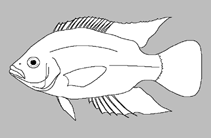
>
Cichliformes (Cichlids, convict blennies) >
Cichlidae (Cichlids) > Pseudocrenilabrinae
Etymology: Haplochromis: Greek, Haploos = single + Greek, chromis = a fish, perhaps a perch (Ref. 45335).
Eponymy: Johann G Hermann Schubotz (1881–1955) was a German naturalist who was an Assistant in Zoology at the Humboldt University, Berlin, and participated in the two expeditions that Duke Adolf Friedrich zu Mecklenburg undertook to Equatorial Africa (1907– [...] (Ref. 128868), visit book page.
More on author: Greenwood.
Umwelt: Milieu / Klimazone / Tiefenbereich / Verbreitungsgebiet
Ökologie
; süßwasser benthopelagisch; standorttreu. Tropical; 1°N - 1°S
Africa: Lake George and Kazinga Channel (and probably Lake Edward as well).
Größe / Gewicht / Alter
Geschlechtsreife: Lm ? range ? - ? cm
Max length : 7.9 cm SL Männchen/unbestimmt; (Ref. 4983)
Commonly found in muddy bays and near papyrus fringed shorelines, but rarely encountered in open waters (Ref. 4983). The presence of plant and other organic debris, together with dipteran larvae in the stomach suggests bottom feeding, possibly insectivorous habits (Ref. 558).
Lebenszyklus und Paarungsverhalten
Geschlechtsreife | Fortpflanzung | Ablaichen | Eier | Fruchtbarkeit | Larven
Mouthbrooding by females.
van Oijen, M.J.P., J. Snoeks, P.H. Skelton, C. Maréchal and G.G. Teugels, 1991. Haplochromis. p. 100-184. In J. Daget, J.-P. Gosse, G.G. Teugels and D.F.E. Thys van den Audenaerde (eds.) Check-list of the freshwater fishes of Africa (CLOFFA). ISNB, Brussels; MRAC, Tervuren; and ORSTOM, Paris. Vol. 4. (Ref. 4983)
IUCN Rote Liste Status (Ref. 130435: Version 2025-2 (Global))
Bedrohung für Menschen
Harmless
Nutzung durch Menschen
Tools
Zusatzinformationen
Download XML
Internet Quellen
Schätzungen auf der Grundlage von Modellen
Phylogenetischer Diversitätsindex (Ref.
82804): PD
50 = 0.5000 [Uniqueness, from 0.5 = low to 2.0 = high].
Bayesian length-weight: a=0.00389 (0.00180 - 0.00842), b=3.12 (2.94 - 3.30), in cm total length, based on all LWR estimates for this body shape (Ref.
93245).
Trophische Ebene (Ref.
69278): 2.4 ±0.21 se; based on food items.
Widerstandsfähigkeit (Ref.
120179): hoch, Verdopplung der Population dauert weniger als 15 Monate. (Preliminary K or Fecundity.).
Anfälligkeit der Fischerei (Ref.
59153): Low vulnerability (10 of 100).
🛈