>
Stomiiformes (Lightfishes and dragonfishes) >
Sternoptychidae (Marine hatchetfishes) > Sternoptychinae
Etymology: Polyipnus: Greek, poly = a lot of + Greek, ipnos = lanterns; laruei: Named for William Larue who collected the holotype.
Eponymy: Pierre and William Larue are yachtsmen who collected (and photographed) the holotype off the coast of New Caledonia (2014). The specimen was found dead and floating on the surface. (Ref. 128868), visit book page.
Ambiente: milieu / zona climática / intervalo de profundidade / gama de distribuição
Ecologia
marinhas batipelágico. Deep-water
Distribuição
Territórios | Áreas FAO | Ecossistemas | Ocorrências | Mapa dos pontos | Introduções | Faunafri
Western Pacific: New Caledonia.
Tamanho / Peso / Idade
Maturidade: Lm ? range ? - ? cm
Max length : 4.6 cm SL macho/indeterminado; (Ref. 115573)
Descrição breve
Chaves de identificação | Morfologia | Morfometria
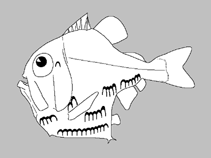
Raios dorsais moles (total) : 11; Raios anais moles: 15; Vértebras: 32. This member of the Polyipnus spinosus species group has the following unique characters: with a single OVB photophore (vs. three in other members); VAV, ACA and ACB photophores form a nearly continuous series in the form of a shallow, sigmoidal curve along the ventral margin of the body from the pelvic-fin base to near the insertion of the posteriormost anal-fin ray (vs. a noticeable space between the VAV and ACA photophores in other members except P. fraseri with no ACA photophores, but there is a gap between the VAV and ACB photophores); and the ACA photophores are separate from each other, not united in a common organ; a combination of the following features further serve to distinguish the new species - relatively large eye with diameter 22.4 % SL; with spines on photophore scales of PV, VAV, ACB, and ACC clusters; with bifurcated posttemporal spines with prominent serration; ACB photophores 6; gill rakers 25 on left side, and 26 on right; a long and broad lateral pigment bar extending below the lateral midline (Ref. 115573).
Body shape (shape guide): short and / or deep; Cross section: compressed.
Ciclo de vida e comportamento de acasalamento
Maturidade | Reprodução | Desova | Ovos | Fecundidade | Larvas
Vourey, E., C. Dupoux and A.S. Harold, 2017. A new species of Polyipnus (Stomiiformes: Sternoptychidae) from the Western South Pacific. Zootaxa 4263(3):567-577. (Ref. 115573)
Categoria na Lista Vermelha da IUCN (Ref. 130435: Version 2025-2 (Global))
Ameaça para o homem
Harmless
Utilização humana
Ferramentas
Relatórios especiais
Descarregue XML
Fontes da internet
Estimativas baseadas em modelos
Índice de diversidade filogenética (Ref.
82804): PD
50 = 0.5000 [Uniqueness, from 0.5 = low to 2.0 = high].
Bayesian length-weight: a=0.02239 (0.01012 - 0.04954), b=2.94 (2.75 - 3.13), in cm total length, based on LWR estimates for this (Sub)family-body shape (Ref.
93245).
Nível Trófico (Ref.
69278): 3.2 ±0.3 se; based on size and trophs of closest relatives
Resiliência (Ref.
120179): Elevada, tempo mínimo de duplicação da população menor que 15 meses (Preliminary K or Fecundity.).
Vulnerabilidade da pesca (Ref.
59153): Low vulnerability (10 of 100).
🛈