>
Perciformes/Cottoidei (Sculpins) >
Liparidae (Snailfishes)
Etymology: Pseudoliparis: Greek, pseudes = false + Greek,liparis = fat (Ref. 45335); swirei: Named for Herbert Swire (Mariana Trench has the ocean’s deepest point, Challenger Deep - named for HMS Challenger - a trench discovered in 1875 with the deepest sounding of 8,184 m, and was christened Swire Deep - after Herbert Swire, the ship’s First Navigating Sublieutenant).
Eponymy: Herbert Swire (d: 1934), after whom Swire Deep in the Mariana Trench is named, was the First Navigating Sub-Lieutenant on HMS Challenger. [...] (Ref. 128868), visit book page.
Ambiente: milieu / zona climatica / distribuzione batimetrica / gamma di distribuzione
Ecologia
marino batidemersale; distribuzione batimetrica 6198 - 8178 m (Ref. 131045), usually 7000 - 8000 m (Ref. 116641). Deep-water
Western Central Pacific: Mariana Trench.
Dimensione / Peso / Età
Maturità: Lm ? range ? - ? cm
Max length : 22.6 cm SL maschio/sesso non determinato; (Ref. 116641)
Breve descrizione
Chiavi di identificazione | Morfologia | Morfometria
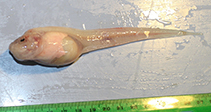
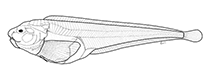
Raggi dorsali molli (totale) : 51 - 58. This species possess the following characters together with its congeners: with a well-developed disk and a pair of nostrils; no pseudobranchia and pleural ribs; four radials in the pectoral girdle, which has neither notches nor fenestrae; hypural plate divided by a distal slit; a moderately well-developed disk (easily damaged in collection). It is distinguished from the two other known Pseudoliparis species by the following: differs from P. belyaevi by having a distinct lower pectoral-fin lobe (but similar to that seen in P. amblystomopsis); differs from P. amblystomopsis in having more dorsal-fin rays 55 (51-58) [vs. 49 (49-52)], more anal-fin rays 48 (43-49) [(vs. 43 (42-45)], more vertebrae 61 (56-62) [vs. 55-57], although these ranges somewhat overlap; differs P. amblystomopsis in having shorter head length, 17.0-21.7 %SL (vs. 21.6-24.0 %SL) (Ref. 116641).
Body shape (shape guide): elongated; Cross section: oval.
This species was reported to be abundant at depths of ca. 7,000-8,000 m and video records showed large aggregations of different-sized individuals attracted to the bait (mackerel) and fed on swarms of amphipods. Smaller individuals were caught at greater depths and no individuals were seen at depths below 8,200 m, which is apparently the physiological depth limit for teleosts. Ripe females had eggs up to 9.4 mm in diameter, among the largest teleost eggs recorded; 0.4 mm smaller than the largest record. Eggs were unsorted within gonad, with the largest eggs free and interspersed within a matrix of smaller eggs. No developmental structures were visible within even the largest eggs. Two distinct size classes of eggs present with up to 23 large eggs (>5 mm) and up to 851 small eggs of less than half the diameter of the larger size class; rarely in intermediate stages. Individuals with only small eggs had maximum egg sizes ranging from 0.7 to 1.4 mm. Genital papilla is visible in freshly collected males, and is oriented anteriorly (Ref. 116641).
.
A self-powered robot that can dive into the ocean's deepest trench was largely inspired by the bones in the skull of P. swirae (Ref. 124589).
Ciclo vitale e comportamento di accoppiamento
Maturità | Riproduzione | Deposizione | Uova | Fecondità | Larve
Gerringer, M.E., T.D. Linley, A.J. Jamieson, E. Goetze and J.C. Drazen, 2017. Pseudoliparis swirei sp. nov.: A newly-discovered hadal snailfish (Scorpaeniformes: Liparidae) from the Mariana Trench. Zootaxa 4358(1):161-177. (Ref. 116641)
Stato della Lista Rossa IUCN (Ref. 130435: Version 2025-2 (Global))
Minaccia per l'uomo
Harmless
Usi umani
Pesca: di nessun interesse
Strumenti
Rapporti speciali
Scarica XML
Fonti Internet
Stime basate su modelli
Indice di diversità filogenetica (Fonte Biblio.
82804): PD
50 = 0.6250 [Uniqueness, from 0.5 = low to 2.0 = high].
Bayesian length-weight: a=0.00525 (0.00237 - 0.01161), b=3.15 (2.96 - 3.34), in cm total length, based on LWR estimates for this (Sub)family-body shape (Ref.
93245).
Livello trofico (Fonte Biblio.
69278): 3.6 ±0.6 se; based on size and trophs of closest relatives
Resilienza (Fonte Biblio.
120179): Alto, tempo minimo di raddoppiamento della popolazione meno di 15 mesi (Preliminary K or Fecundity.).
Vulnerabilità della pesca (Ref.
59153): Low vulnerability (18 of 100).
🛈