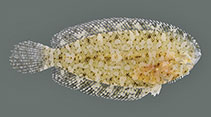
การจำแนกประเภท / ชื่อ
ชื่อสามัญ | ชื่อพ้อง | Catalog of Fishes(สกุล, ชนิด) | ITIS | CoL | WoRMS | Cloffa
>
Pleuronectiformes (Flatfishes) >
Soleidae (Soles)
Etymology: Aseraggodes: Greek, aggos, -eos, -ous = vessel, uterus, carapace of a crab + Greek, aseros, -a, -on = to remove the appetite (Ref. 45335); kruppi: Named for Dr. Fareed Krupp, in recognition of his research on fishes, especially in the Red Sea.
Eponymy: Professor Dr Fareed Krupp was Curator of Fishes at the Senckenberg Research Institute, Frankfurt, and a leading authority on the fishes of the Red Sea, which he has researched for more than two decades. [...] (Ref. 128868), visit book page.
สิ่งแวดล้อม : สิ่งแวดล้อม / เขตภูมิอากาศ / ระดับความลึก / ระยะการกระจายสินค้า
นิเวศวิทยา
เกี่ยวกับทะเล,น้ำเค็ม เกี่ยวกับหินโสโครก; ระดับความลึก ? - 2 m (Ref. 95111). Tropical
Western Indian Ocean: Red Sea, Saudi Arabia and Eritrea.
ขนาด / น้ำหนัก / อายุ
วัยเจริญพันธุ์: Lm ? range ? - ? cm
Max length : 2.4 cm SL เพศผู้/กระเทย; (Ref. 95111)
คำอธิบายสั้นๆ
เครื่องมือที่ใช้ในการแยกชนิดสัตว์,สิ่งมีชีวิตออกจากกัน | สัณฐานวิทยา | ความยาวต่างๆ
เงี่ยงครีบหลัง (รวม) : 0; ก้านครีบอ่อนที่หาง (รวม) : 58; เงี่ยงครีบก้น: 0; ก้านครีบอ่อนที่ก้น: 39; สัตว์มีกระดูกสันหลัง: 32. This species is distinguished by the following characters: D 58; A 39; caudal rays 18; lateral-line scales 68 (including 8 anterior to upper end of gill opening); vertebrae 32; dorsal pterygiophores anterior to fourth neural spine 15; body depth 2.6 in SL; head length 3.65 in SL; snout length 3.05 in head length; with a row of 13 lappet-like cirri on ventral margin of head; with caudal peduncle, its depth 6.4 in head length; caudal fin rounded, 3.7 in SL; longest dorsal ray 1.6 in head length; colour in alcohol pale beige, scales narrowly rimmed with brown; 3 longitudinal rows of diffuse dark brown blotches on body; unmarked fins; color when fresh pale yellow, the dark markings more heavily pigmented; head and body with large irregular white blotches, varying from nearly round (most larger than eye) to vermiculate; median fins with transparent membranes, the rays yellowish, spotted with dark brown and white; dorsal and anal fins with a row of large irregular white blotches on about basal half; pelvic fins are white; lips and eyes whitish, the pupils rimmed in light yellow; cirri ventrally on head white (Ref. 95111).
Body shape (shape guide): short and / or deep; Cross section: flattened.
This species was collected from sand in an isolated patch reef about 3 m in diameter, about 100 m from shore on the sheltered east side of a small island near the coast of Saudi Arabia and it was about 15 m from the steep outer-reef slope (Ref. 95111).
วงจรชีวิตและพฤติกรรมการผสมพันธุ์
วัยเจริญพันธุ์ | การสืบพันธุ์ | การวางไข่ | เซลสืบพันธ์ของเพศเมีย(ไข่) | ความดกของไข่ | ตัวอ่อน
Randall, J.E., S.V. Bogorodsky and O. Mal, 2013. Four new soles (Pleuronectiformes: Soleidae) of the genus Aseraggodes from the western Indian Ocean. J. Ocean Sci. Found. 8:1-17. (Ref. 95111)
สถานะบัญชีแดงของ IUCN (Ref. 130435: Version 2025-2 (Global))
ภัยคุกคามต่อมนุษย์
Harmless
การใช้ของมนุษย์
เครื่องมือ
รายงานพิเศษ
ดาวน์โหลด XML
แหล่งที่มาจากอินเตอร์เน็ต
การประมาณค่าตามแบบจำลอง
ดัชนีความหลากหลายทางวิวัฒนาการ (อ้างอิง
82804): PD
50 = 0.5000 [Uniqueness, from 0.5 = low to 2.0 = high].
Bayesian length-weight: a=0.00955 (0.00454 - 0.02011), b=3.07 (2.90 - 3.24), in cm total length, based on LWR estimates for this (Sub)family-body shape (Ref.
93245).
ระดับชั้นอาหาร (อ้างอิง
69278): 3.1 ±0.5 se; based on size and trophs of closest relatives
ความสามารถในการกลับคืนสู่ปกติ (อ้างอิง
120179): ความสูง, เวลาต่ำสุดที่จะทำให้ประชากรเพิ่มขึ้นเป็น 2 เท่าใช้เวลาน้อยกว่า 15 เดือน (Preliminary K or Fecundity.).
ความเสี่ยงต่อการตกปลา (Ref.
59153): Low vulnerability (10 of 100).
🛈