Clasificación / Nombres
Nombres comunes | Sinónimos | Catalog of Fishes(Género, Especie) | ITIS | CoL | WoRMS | Cloffa
>
Pleuronectiformes (Flatfishes) >
Soleidae (Soles)
Etymology: Aseraggodes: Greek, aggos, -eos, -ous = vessel, uterus, carapace of a crab + Greek, aseros, -a, -on = to remove the appetite (Ref. 45335); andersoni: Named for Dr. R. Charles Anderson, one of the collectors of the holotype and who assisted the first author during the latter’s visits to the Republic of Maldives.
Eponymy: Dr R Charles Anderson is a marine ecologist who was one of the collectors of the sole holotype. He assisted the first author during the latter’s visits to the Republic of Maldives, and is the author of: Reef Fishes of the Maldives (2007). (Ref. 128868), visit book page.
Entorno: milieu / zona climática / rango de profundidad / gama de distribución
Ecología
marino asociado a arrecife; rango de profundidad 1 - 2 m (Ref. 95111). Tropical
Western Indian Ocean: Maldives only but expected to occur in other tropical countries in the area.
Tamaño / Peso / Edad
Madurez: Lm ? range ? - ? cm
Max length : 2.4 cm SL macho / no sexado; (Ref. 95111)
Descripción breve
Claves de identificación | Morfología | Morfometría
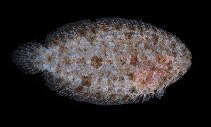
Espinas dorsales (total) : 0; Radios blandos dorsales (total) : 68; Espinas anales: 0; Radios blandos anales: 49; Vértebra: 37. This species is distinguished by the following characters: D 68; A 49; lateral-line scales 71; vertebrae 37; dorsal pterygiophores anterior to fourth neural spine 9; body depth 2.4 in SL; head length 4.1 in SL; no caudal peduncle; snout length 2.95 in head length; colour in alcohol uniformly pale yellowish brown, when fresh pale brown with numerous, irregular, bluish white blotches, scattered small dark brown spots, and with 3 rows of large brown blotches (one at base of dorsal fin, one at base of anal fin, and one along lateral line); a large orange-red area over abdomen and posterior head; iris light yellow with spoke-like brown bands; median fins with a row of large dark brown spots at the base, and smaller spots peripherally (Ref. 95111).
Body shape (shape guide): short and / or deep; Cross section: flattened.
Ciclo vital y comportamiento de apareamiento
Madurez | Reproducción | Puesta | Huevos | Fecundidad | Larva
Randall, J.E., S.V. Bogorodsky and O. Mal, 2013. Four new soles (Pleuronectiformes: Soleidae) of the genus Aseraggodes from the western Indian Ocean. J. Ocean Sci. Found. 8:1-17. (Ref. 95111)
Situación en la Lista Roja de la UICN (Ref. 130435: Version 2025-2 (Global))
Amenaza para el ser humano
Harmless
Usos humanos
Herramientas
Informes especiales
Descargar XML
Fuentes de Internet
Estimaciones basadas en modelos
Índice de diversidad filogenética (Referencia
82804): PD
50 = 0.5000 [Uniqueness, from 0.5 = low to 2.0 = high].
Bayesian length-weight: a=0.00955 (0.00454 - 0.02011), b=3.07 (2.90 - 3.24), in cm total length, based on LWR estimates for this (Sub)family-body shape (Ref.
93245).
Nivel trófico (Referencia
69278): 3.1 ±0.5 se; based on size and trophs of closest relatives
Resiliencia (Referencia
120179): Alto, población duplicada en un tiempo mínimo inferior a 15 meses (Preliminary K or Fecundity.).
Vulnerabilidad pesquera (Ref.
59153): Low vulnerability (10 of 100).
🛈