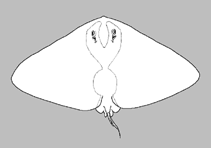
Classificação / Nomes
Nomes comuns | Sinônimos | Catalog of Fishes(Gênero, Espécies) | ITIS | CoL | WoRMS | Cloffa
Elasmobranchii (tubarões e raias) (sharks and rays) >
Myliobatiformes (Stingrays) >
Gymnuridae (Butterfly rays)
Etymology: Gymnura: Greek, gymnos = naked + Greek, oura = tail (Ref. 45335); lessae: Named for Dr. Rosangela Lessa, Brazilian researcher working for the conservation of sharks and rays in her country.
Eponymy: Dr Rosângela Paula Teixeira Lessa, a lecturer at the Federal Rural University of Pernambuco (UFRPE), is a Brazilian researcher working for the conservation of sharks and rays in her country. [...] (Ref. 128868), visit book page.
Meio ambiente: milieu / Zona climática / intervalo de profundidade / faixa de distribuição
Ecologia
marinhas demersal. Subtropical
Western Atlantic: USA, from southern Massachusetts and Buzzards Bay to the Gulf of Mexico (including the Gulf Coast of the US and Mexico). And probably may be extended to the northern Caribbean Sea (Bahamas and Jamaica).
Tamanho / Peso / Idade
Maturidade: Lm ? range ? - ? cm
Max length : 60.9 cm WD macho/indeterminado; (Ref. 116399); 110.0 cm WD (female)
This demersal species lives along the coast on sandy and muddy bottoms. Reported stomach contents include fishes, crustaceans, molluscs and other invertebrates. This species is matrotophic viviparous (lipid histotrophy). Young are reported to be produced from late May through July and into August, and probably even later in the season. Pregnancy is reported to occur during the summer months (Ref. 116399).
Ciclo de vida ou comportamento de acasalamento
Maturidade | Reprodução | Desova | Ovos | Fecundidade | Larvas
Yokota, L. and M.R. de Carvalho, 2017. Taxonomic and morphological revision of butterfly rays of Gymnura micrura (Bloch & Schneider, 1801) species complex, with the description of two new species (Myliobatiformes: Gymnuridae). Zootaxa 4332(1):1-74. (Ref. 116399)
Status na Lista Vermelha da UICN (Ref. 130435: Version 2025-2 (Global))
Ameaça para os humanos
Harmless
Uso pelos humanos
Ferramentas
Relatórios especiais
Baixar XML
Fontes da internet
Estimativas baseadas em modelos
Índice de diversidade filogenética (Ref.
82804): PD
50 = 0.5000 [Uniqueness, from 0.5 = low to 2.0 = high].
Bayesian length-weight: a=0.00851 (0.00393 - 0.01841), b=3.08 (2.88 - 3.28), in cm total length, based on LWR estimates for this (Sub)family-body shape (Ref.
93245).
Nível Trófico (Ref.
69278): 3.8 ±0.6 se; based on size and trophs of closest relatives
Vulnerabilidade da pesca (Ref.
59153): Moderate vulnerability (43 of 100).
🛈