Clasificación / Nombres
Nombres comunes | Sinónimos | Catalog of Fishes(Género, Especie) | ITIS | CoL | WoRMS | Cloffa
>
Siluriformes (Catfishes) >
Mochokidae (Squeakers or upside-down catfishes) > Chiloglanidinae
Etymology: Chiloglanis: Greek, cheilos = lip + Greek, glanis = a fish that can eat the bait without touching the hook; a cat fish (Ref. 45335); kabaensis: The specific epithet refers to the Kaba River drainage (Little Scarcies), where the species is endemic (Ref. 116018).
Entorno: milieu / zona climática / rango de profundidad / gama de distribución
Ecología
; agua dulce bentopelágico. Tropical
Africa: Little Scarcies River drainage in Guinea and possibly also in Sierra Leone (Ref. 116018).
Tamaño / Peso / Edad
Madurez: Lm ? range ? - ? cm
Max length : 4.6 cm SL macho / no sexado; (Ref. 116018)
Descripción breve
Claves de identificación | Morfología | Morfometría
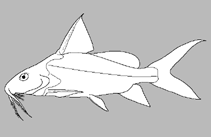
Espinas dorsales (total) : 2; Radios blandos dorsales (total) : 4 - 5; Espinas anales: 0; Radios blandos anales: 8 - 10. Diagnosis: Chiloglanis kabaensis is distinguished from C. waterloti and C. longibarbis in having more mandibular teeth in the functional row, and is distinguished from C. camarabounyi, C. dialloi, C. loffabrevum, C. tweddlei, C. pezoldi, C. lamottei, and C. polyodon in having fewer mandibular teeth in the functional row; it is easily distinguished from Chiloglanis aff. micropogon in having moderately long mandibular barbels vs. absent or reduced; it is distinguished from C. normani in having males without sexually dimorphic anal and caudal fins; it is distinguished from C. occidentalis and C. nzerekore in having shorter dorsal and pectoral spines, and shorter maxillary barbels; it can be distinguished from C. kolente in having shorter maxillary barbels and lateral mandibular barbels, and in attaining a larger maximum standard length, 45.9 vs. 25.7 (Ref. 116018).
Body shape (shape guide): elongated.
This species is collected in riffles and faster flowing water around large rocks and woody debris (Ref. 116018).
Ciclo vital y comportamiento de apareamiento
Madurez | Reproducción | Puesta | Huevos | Fecundidad | Larva
Schmidt, R.C., H.L. Bart, F. Pezold and J.P. Friel, 2017. A biodiversity hotspot heats up: Nine new species of suckermouth catfishes (Mochokidae: Chiloglanis) from Upper Guinean forest steams in West Africa. Copeia 105(2):301-338. (Ref. 116018)
Situación en la Lista Roja de la UICN (Ref. 130435: Version 2025-2 (Global))
Amenaza para el ser humano
Harmless
Usos humanos
Pesquerías: sin interés
Herramientas
Informes especiales
Descargar XML
Fuentes de Internet
Estimaciones basadas en modelos
Índice de diversidad filogenética (Referencia
82804): PD
50 = 0.5000 [Uniqueness, from 0.5 = low to 2.0 = high].
Bayesian length-weight: a=0.00389 (0.00180 - 0.00842), b=3.12 (2.94 - 3.30), in cm total length, based on all LWR estimates for this body shape (Ref.
93245).
Nivel trófico (Referencia
69278): 3.1 ±0.4 se; based on size and trophs of closest relatives
Resiliencia (Referencia
120179): Alto, población duplicada en un tiempo mínimo inferior a 15 meses (Preliminary K or Fecundity.).
Vulnerabilidad pesquera (Ref.
59153): Low vulnerability (10 of 100).
🛈