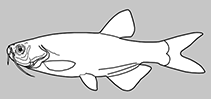
Classificatie / Namen
Lokale namen | Synoniemen | Catalog of Fishes(Genus, Soort(en)) | ITIS | CoL | WoRMS | Cloffa
>
Cypriniformes (Carps) >
Danionidae (Danios) > Rasborinae
Etymology: rohani: Named for Rohan Pethiyagoda, founder of the Wildlife Heritage Trust of Sri Lanka (WHT), for his special commitment to the ichthyofauna of Sri Lanka and India; and for continuing support of biodiversity research and conservation in Sri Lanka.
Eponymy: Tilak Rohan David Pethiyagoda (d: 1955) (abbreviated to Rohan Pett by deed poll in 2010) is a Sri Lankan biologist. [...] (Ref. 128868), visit book page.
Milieu: milieu / Klimaatzone / Diepte / verspreidingsgebied
Ecologie
; zoet water benthopelagisch. Tropical
Asia: Walawe River basin in Sri Lanka.
Grootte / Gewicht / Leeftijd
Maturiteit: Lm ? range ? - ? cm
Max length : 3.6 cm SL mannelijk / geslacht onbekend; (Ref. 94541); 3.1 cm SL (female)
Korte beschrijving
Determinatiesleutels | Morfologie | Morfometrie
Dorsale zachte stralen (totaal) : 10; Anale zachte stralen: 9; Wervels: 29. Rasboroides rohani can be diagnosed from other congeners, R. vaterifloris and R. nigromarginatus, by having the dorsal-fin origin 3 (vs. 1) scale-widths behind pelvic-fin origin; and body depth 35.6-40.0 % SL in males, 33.3-36.8 % SL in females (vs. 31.1-32.8 in males and 31.0-31.7 in female R. vaterifloris, 28.2-33.0 in male and 26.9-29.1 in female R. nigromarginatus). It can be distinguished from R. pallidus by its greater size (up to 35.5 mm SL, vs. 24.6) and having 1/2 8 1/2 (vs. 1/2 6 1/2 or 1/2 7 1/2) scales on body in transverse line, 25-28 (vs. 20-24) scales in lateral series, 1 (vs. 2) lateral process on the kinethmoid and the pharyngeal-teeth formula of 5,4,2-2,4,5 (vs. 5,4,3-3,4,5). In addition, females of R. rohani can be separated from females of R. pallidus by having a lesser eye diameter (29-34 % HL, vs. 39-40) and a lesser interorbital width (25-28 % HL, vs. 33- 36) (Ref. 94541).
Body shape (shape guide): fusiform / normal.
Occurs in shallow, slow-flowing, shady streams with sandy-silt substrate and dense leaf litter in
submontane forest. Sympatric with other fishes: Pethia nigrofasciata, Puntius titteya, Belontia signata and Rasbora microcephala (Ref. 94541).
Levenscyclus en paargedrag
Maturiteit | Voortplanting | Paaien | Eieren | Fecunditeit | Larven
Batuwita, S., M. de Silva and U. Edirisinghe, 2013. A review of the danionine genera Rasboroides and Horadandia (Pisces: Cyprinidae), with description of a new species from Sri Lanka. Ichthyol. Explor. Freshwat. 24(2):121-140. (Ref. 94541)
Status op de Rode Lijst van het IUCN (Ref. 130435: Version 2025-2 (Global))
Gevaar voor de mens
Harmless
Gebruik door de mens
Tools
Speciale rapporten
Download XML
Internetbronnen
Schattingen op basis van modellen
Fylogenetische diversiteitsindex (Ref.
82804): PD
50 = 0.5625 [Uniqueness, from 0.5 = low to 2.0 = high].
Bayesian length-weight: a=0.00891 (0.00382 - 0.02082), b=3.02 (2.82 - 3.22), in cm total length, based on LWR estimates for this (Sub)family-body shape (Ref.
93245).
Trofisch niveau (Ref.
69278): 3.1 ±0.4 se; based on size and trophs of closest relatives
Weerstandsvermogen (Ref.
120179): Hoog, minimale populatieverdubbelingstijd minder dan 15 maanden (Preliminary K or Fecundity.).
Kwetsbaarheid van de visserij (Ref.
59153): Low vulnerability (10 of 100).
🛈