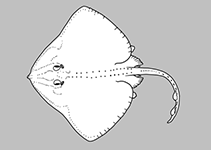
การจำแนกประเภท / ชื่อ
ชื่อสามัญ | ชื่อพ้อง | Catalog of Fishes(สกุล, ชนิด) | ITIS | CoL | WoRMS | Cloffa
sub class Elasmobranchii (ฉลามและกระเบน) (sharks and rays) >
Rajiformes (Skates and rays) >
Arhynchobatidae (Softnose skates)
Etymology: Notoraja: Greek, noton = back + Latin, raja = fish, Raja sp. (Ref. 45335); sereti: Named after the highly respected French ichthyologist, Dr. Bernard Séret.
Eponymy: Dr Bernard Séret (d: 1949) is an ichthyologist and marine biologist who is a senior scientist at IRD (Institut de Recherche pour le Développement) and is currently hosted by the Department of Systematics and Evolution, Muséum National d’Histoire [...] (Ref. 128868), visit book page.
สิ่งแวดล้อม : สิ่งแวดล้อม / เขตภูมิอากาศ / ระดับความลึก / ระยะการกระจายสินค้า
นิเวศวิทยา
เกี่ยวกับทะเล,น้ำเค็ม สัตว์หน้าดินในเขตน้ำลึก; ระดับความลึก 800 - 980 m (Ref. 116308). Tropical
การแพร่กระจาย
อาณาเขต | พื้นที่จำแนกตาม FAO | ระบบนิเวศหลายระบบ | การปรากฏขึ้น,การเกิดขึ้น,พบ | ตำแหน่งบนแผนที่ | การแนะนำ | Faunafri
Western Central Pacific: Papua New Guinea.
ขนาด / น้ำหนัก / อายุ
วัยเจริญพันธุ์: Lm ? range ? - ? cm
Max length : 45.9 cm TL (female)
คำอธิบายสั้นๆ
เครื่องมือที่ใช้ในการแยกชนิดสัตว์,สิ่งมีชีวิตออกจากกัน | สัณฐานวิทยา | ความยาวต่างๆ
This medium-size species is distinguished by the following set of characters: disc wider than long, width 47.1-50.3% TL, length 42.0-43.6% TL; head short (dorsal head length 15.2-16.2% TL; ventral head length 21.6-22.9% TL); snout relatively short (preorbital length 10.1-11.1% TL; ventral snout length 11.2-12.1% TL); interspiracular distance 5.3-5.9 TL, internasal distance 6.2-6.8% TL, preorbital length 2.4-3.0 times orbit length and 2.9-3.6 times interorbital; dorsal fins two, interdorsal space 1.1-1.9% TL; tail width at pelvic-fin axil 0.9-1.6 times its height; preorbital thorn single and small ; dorsal and most of ventral surface of disc entirely velvety, covered with fine denticles; adolescent male with median disc and pelvic fins naked; in females, anterior pelvic-fin lobe naked (skin naked or with sparse denticles ventrally on mid belly, chin, nasal curtain, and around cloaca); tail is long and slender, entirely velvety and without thorn-like denticles; lateral tail folds are moderately well developed; nasal lobes expanded, width of nasal curtain 7.9-8.3% TL; anterior pelvic-fin lobe is slightly shorter or similar length to posterior lobe; dorsal and ventral surfaces are greyish brown to dark bluish grey; total pectoral-fin radials 58-60; monospondylous centra 23-25, total diplospondylous centra 103-106, total centra 126-131 (Ref. 116308).
Body shape (shape guide): other; Cross section: flattened.
The species is known from three type specimens consisting of two females (45.9 and 45.8 cm TL) and an adolescent male (36.3 cm TL); based on the adolescent male size, the females are most likely adults (Ref. 116308).
วงจรชีวิตและพฤติกรรมการผสมพันธุ์
วัยเจริญพันธุ์ | การสืบพันธุ์ | การวางไข่ | เซลสืบพันธ์ของเพศเมีย(ไข่) | ความดกของไข่ | ตัวอ่อน
White, W.T., P.R. Last and R.R. Mana, 2017. A new species of velvet skate, Notoraja sereti n.sp. (Rajiformes: Arhynchobatidae) from Papua New Guinea. Zootaxa 4244(2):219-230. (Ref. 116308)
สถานะบัญชีแดงของ IUCN (Ref. 130435: Version 2025-2 (Global))
ภัยคุกคามต่อมนุษย์
Harmless
การใช้ของมนุษย์
การประมง: ไม่มีผลประโยชน์
เครื่องมือ
รายงานพิเศษ
ดาวน์โหลด XML
แหล่งที่มาจากอินเตอร์เน็ต
การประมาณค่าตามแบบจำลอง
ดัชนีความหลากหลายทางวิวัฒนาการ (อ้างอิง
82804): PD
50 = 0.5000 [Uniqueness, from 0.5 = low to 2.0 = high].
Bayesian length-weight: a=0.00550 (0.00279 - 0.01081), b=3.11 (2.94 - 3.28), in cm total length, based on LWR estimates for this (Sub)family-body shape (Ref.
93245).
ระดับชั้นอาหาร (อ้างอิง
69278): 3.8 ±0.7 se; based on size and trophs of closest relatives
ความสามารถในการกลับคืนสู่ปกติ (อ้างอิง
120179): ขนาดกลาง, เวลาต่ำสุดที่จะทำให้ประชากรเพิ่มขึ้นเป็น 2 เท่าใช้เวลา 1.4 - 4.4 ปี (Preliminary K or Fecundity.).
ความเสี่ยงต่อการตกปลา (Ref.
59153): Moderate vulnerability (36 of 100).
🛈