>
Gobiiformes (Gobies) >
Gobiidae (Gobies) > Gobiinae
Etymology: Grallenia: Named for Gerald R. Allen, (G+R+Allen+suffix '-ia'), in honor of his great contribution to our knowledge of the diversity of coral-reef fishes; rubrilineata: Name from Latin 'rubrilineata' meaning 'red-lined' or 'red-striped'; referring to the marking on the dorsal fin of adult males; treated as a feminine compound adjective.
Eponymy: Dr Gerald Ray Allen (d: 1942) The genus was named to honour “…his great contribution to our knowledge of the diversity of coral-reef fishes.” (See Allen, GR) (Ref. 128868), visit book page.
Environnement : milieu / zone climatique / profondeur / gamme de distribution
Écologie
marin récifal; profondeur 12 - 15 m (Ref. 116128). Tropical
Western Central Pacific: Philippines and possibly Malaysia.
Taille / Poids / Âge
Maturité: Lm ? range ? - ? cm
Max length : 1.5 cm SL mâle / non sexé; (Ref. 116128); 1.5 cm SL (female)
Description synthétique
Clés d'identification | Morphologie | Morphométrie
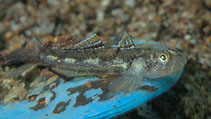
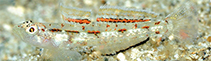
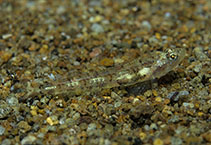
Épines dorsales (Total) : 7; Rayons mous dorsaux (Total) : 9 - 11; Épines anales: 1; Rayons mous anaux: 9 - 11; Vertèbres: 27 - 28. This species is distinguished by the following characters: D VI+I,9-11 (usually 10); A I,9-11 (usually 10); first dorsal-fin spine is not produced into filament in either sex; no pelvic frenum nor head pores; posterior longitudinal scale 17-22, usually extending forward to at least level of second-dorsal-fin origin, body anterior to level of middle of second dorsal fin with numerous scales; body depth at pelvic-fin origin 12.8-16.4% in SL; colour in life translucent with reddish-brown markings consisting of 8-12 widely separated small spots or short irregular bars along dorsal profile of body, an interrupted stripe from upper rear edge of opercle to upper caudal peduncle (each segment progressively shorter with increasingly wider space between, proceeding posteriorly) and a longitudinal row of about 9 irregular brown blotches along ventral portion of side; adult male with both dorsal fins with distinctive basal red or red-edged black stripe and anal fin with bold black outer margin (Ref. 116128).
Body shape (shape guide): elongated; Cross section: oval.
Cycle de vie et comportement reproducteur
Maturité | Reproduction | Frai | Œufs | Fécondité | Larves
Allen, G.R. and M.V. Erdmann, 2017. Descriptions of five new species of marine gobies (Teleostei: Gobiidae) of the genus Grallenia) from the tropical western Pacific Ocean. J. Ocean Sci. Found. 27:20-47. (Ref. 116128)
Statut dans la liste rouge de l'IUCN (Ref. 130435: Version 2025-2 (Global))
Menace pour l'homme
Harmless
Utilisations par l'homme
Outils
Articles particuliers
Télécharger en XML
Sources Internet
Estimations basées sur des modèles
Indice de diversité phylogénétique (Réf.
82804): PD
50 = 0.5020 [Uniqueness, from 0.5 = low to 2.0 = high].
Bayesian length-weight: a=0.00741 (0.00347 - 0.01582), b=3.09 (2.91 - 3.27), in cm total length, based on LWR estimates for this (Sub)family-body shape (Ref.
93245).
Niveau trophique (Réf.
69278): 3.0 ±0.3 se; based on size and trophs of closest relatives
Résilience (Réf.
120179): Haut, temps minimum de doublement de population inférieur à 15 mois (Preliminary K or Fecundity.).
Vulnérabilité de la pêche (Ref.
59153): Low vulnerability (10 of 100).
🛈