Elasmobranchii (tubarões e raias) (sharks and rays) >
Myliobatiformes (Stingrays) >
Potamotrygonidae (River stingrays) > Potamotrygoninae
Etymology: Potamotrygon: Greek, potamos = river + Greek, trygon = a sting ray (Ref. 45335).
Eponymy: Alfred Russel Wallace (1823–1913) was an English naturalist, evolutionary scientist, geographer and anthropologist and one of the greatest men of science of his age. [...] (Ref. 128868), visit book page.
Ambiente: milieu / zona climática / intervalo de profundidade / gama de distribuição
Ecologia
; Água doce bentopelágico. Tropical
South America: Rio Negro, Amazonas, Brazil.
Tamanho / Peso / Idade
Maturidade: Lm ? range ? - ? cm
Max length : 31.0 cm WD macho/indeterminado; (Ref. 115939)
Descrição breve
Chaves de identificação | Morfologia | Morfometria
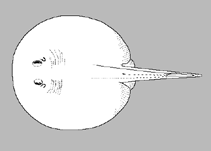
Potamotrygon wallaceidorsal is distinguished by the following characters: dorsal surface of disc light brown, with black irregularly-shaped vermiculate markings forming an amphora- or ?-shaped figure on mid-disc, delimiting light brown reniform areas at disc center, and with subcircular light brown ocellate markings on disc margins; small body size (smallest known Potamotrygon species; largest examined specimen measured 31 cm DW); dorsal spines on tail usually rather low, without broad bases, in one to rarely three irregular rows, but extending posteriorly only to tail mid-length and not to caudal stings, with altogether relatively few spines; denticles on posterior mid-disc and tail base Y-shaped, with a central, anterior, bulbous cusp and usually two posterior pairs of smaller, rounded cusps; and single (anterior) angular cartilage. It differs from P. orbignyi and other "reticulated" species by having a single (anterior) angular cartilage and in the color pattern of the tail, but is easily distinguished based on its size, dorsal tail spine arrangement, and specific details of color pattern (Ref. 115939).
Ciclo de vida e comportamento de acasalamento
Maturidade | Reprodução | Desova | Ovos | Fecundidade | Larvas
Carvalho, M.R. de, R.S. Rosa and M.L.G. De Araújo, 2016. A new species of Neotropical freshwater stingray (Chondrichthyes: Potamotrygonidae) from the Rio Negro, Amazonas, Brazil: the smallest species of Potamotrygon. Zootaza 4107(4):566-586. (Ref. 115939)
Categoria na Lista Vermelha da IUCN (Ref. 130435: Version 2025-2 (Global))
Ameaça para o homem
Harmless
Utilização humana
Ferramentas
Relatórios especiais
Descarregue XML
Fontes da internet
Estimativas baseadas em modelos
Índice de diversidade filogenética (Ref.
82804): PD
50 = 0.5000 [Uniqueness, from 0.5 = low to 2.0 = high].
Bayesian length-weight: a=0.01000 (0.00244 - 0.04107), b=3.04 (2.81 - 3.27), in cm total length, based on all LWR estimates for this body shape (Ref.
93245).
Nível Trófico (Ref.
69278): 3.2 ±0.4 se; based on size and trophs of closest relatives
Vulnerabilidade da pesca (Ref.
59153): High vulnerability (58 of 100).
🛈