>
Gobiiformes (Gobies) >
Gobiidae (Gobies) > Gobiinae
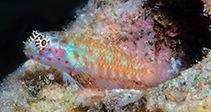
Etymology: Eviota: No etymology given, suggested by Christopher Scharpt: from Latin 'eu' for 'true' and 'iota' for anything very small, in combination 'truly very small' referring to it as being the smallest vertebrate at the time it has benn described by Jenkins (thus, making the suggestion by Scharpt plausible; pictifacies: Name from Latin adjective 'pictus' or painted and the female noun 'facies' for face; referring to the bright red spots on the side of the head, similar to those painted on a clown; treated as a feminine compound adjective.
Milieu: milieu / Klimaatzone / Diepte / verspreidingsgebied
Ecologie
marien rifbewoner; diepte 3 - 8 m (Ref. 115282). Tropical
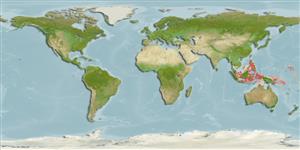
Western Pacific: Indonesia.
Grootte / Gewicht / Leeftijd
Maturiteit: Lm ? range ? - ? cm
Max length : 1.6 cm SL mannelijk / geslacht onbekend; (Ref. 115282); 1.7 cm SL (female)
Korte beschrijving
Determinatiesleutels | Morfologie | Morfometrie
Dorsale stekels (totaal) : 7; Dorsale zachte stralen (totaal) : 9; Anale stekels: 1; Anale zachte stralen: 8. This species is distinguished by the following characters: cephalic sensory-canal pore system complete (pattern 1), with the PITO pore very small; dorsal/anal fin-ray formula 9/8; some of pectoral-fin rays are branched; 5th pelvic-fin ray present; presence of a distinct dark occipital spot (intense in preservative, but visible in life); no series of small dark spots along dorsal-fin bases; 2 separate orange spots behind the eye; distinctive black marks on the underside of the head; side of head with large round red spots; scleral surface of eye with bold dark-brown-and-white markings (Ref. 115282).
Body shape (shape guide): elongated; Cross section: oval.
This species occurs in shallow fringing reef which is subject to significant terrigenous sedimentation and relatively warm water due to the limited circulation in the large bay of Teluk Saleh. Often found resting on live massive coral colonies (Ref. 115282).
Levenscyclus en paargedrag
Maturiteit | Voortplanting | Paaien | Eieren | Fecunditeit | Larven
Greenfield, D.W. and M.V. Erdmann, 2017. Eviota pictifacies, a new dwarfgoby from Sumbawa, Indonesia (Teleostei: Gobiidae). J. Ocean Sci. Found. 27:1-7. (Ref. 115282)
Status op de Rode Lijst van het IUCN (Ref. 130435: Version 2025-2 (Global))
Gevaar voor de mens
Harmless
Gebruik door de mens
Tools
Speciale rapporten
Download XML
Internetbronnen
Schattingen op basis van modellen
Fylogenetische diversiteitsindex (Ref.
82804): PD
50 = 0.5000 [Uniqueness, from 0.5 = low to 2.0 = high].
Bayesian length-weight: a=0.00692 (0.00281 - 0.01706), b=3.09 (2.92 - 3.26), in cm total length, based on LWR estimates for this Genus-body shape (Ref.
93245).
Trofisch niveau (Ref.
69278): 3.0 ±0.3 se; based on size and trophs of closest relatives
Weerstandsvermogen (Ref.
120179): Hoog, minimale populatieverdubbelingstijd minder dan 15 maanden (Preliminary K or Fecundity.).
Kwetsbaarheid van de visserij (Ref.
59153): Low vulnerability (10 of 100).
🛈